Is the CE Marking for China Exports really available?
An industrial company is developing a machine that will be installed during 2027. The project includes remote connection for maintenance, software updates, and various automated functions. However, the declaration of conformity and part of the documentation still refer to Directive 2006/42/EC.
Can that regulation be maintained or should the new one be applied now? European Machinery Regulation?
The answer does not depend solely on when it was manufactured. It is necessary to check when it will be marketed or put into service, what functions it incorporates and what conformity assessment procedure it is subject to.
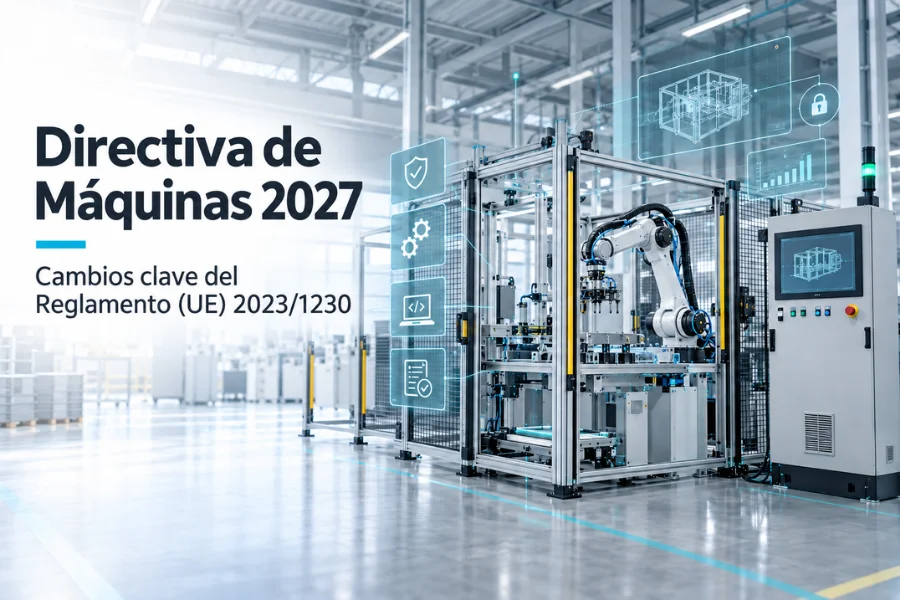
Quick response. The rule commonly known as the «new Machinery Directive» is, in fact, the Regulation (EU) 2023/1230, which will replace the Directive 2006/42/CE and will be applicable in general terms from January 20, 2027. The machines introduced in the Products that have already been put into service before that date continue to be subject to the current Directive. Machines that are already in operation will not have to obtain a new CE marking solely due to this regulatory change, although they will need to be reviewed if they undergo a substantial modification later on.
Is it a new Directive or a Machinery Regulation?
Although many searches and communications use the expression «new Directive on Machinery», the correct designation is Regulations (EU) 2023/1230 of the European Parliament and the Council, concerning machinery.
A directive must be incorporated into the legislation of each State. This is the case with Directive 2006/42/CE, which was transposed in Spain mainly through Royal Decree 1644/2008. A regulation, on the other hand, is directly applicable. The change seeks to reduce differences in interpretation within the European Union.
The new Regulation maintains the foundations of the CE marking: risk assessment, compliance with essential requirements, technical file and EU declaration of conformity. The novelty is its adaptation to digitalization, connectivity and technological evolution.
When does the Machinery Regulation 2023/1230 apply?
The Regulation came into effect in 2023, but it will be applied generally from January 20, 2027. Until Therefore, machines that are placed on the market or put into service must comply with Directive 2006/42/CE.
The manufacturing date is not sufficient. A machine that is finished in 2026, but is first introduced to the market after January 20, 2027, must comply with the Regulation. In a machine manufactured for self-use, the date of commissioning will be decisive.
Therefore, projects whose design, manufacture, import, or integration extends to 2027 should be reviewed from now on. Waiting until the end of the project may force a re-evaluation of the risks, an update of the control system, a revision of the software, or a change in the conformity assessment procedure.
Differences between Directive 2006/42/EC and Regulation 2023/1230
| Appearance | Directive 2006/42/CE | Regulation (EU) 2023/1230 | Practical consequence |
|---|---|---|---|
| Type of standard | It requires national transposition. | It is directly applicable. | More uniform application. |
| Digital environment | Treatment that is not very explicit. | Includes software, connectivity, and computer security. | Digital alterations must be evaluated. |
| Self-evolving systems | Without specific regulation. | It contemplates self-evolving machine learning. | Its evolution should be evaluated. |
| Security software | Less explicit treatment. | It can be a security component. | It requires identification, protection, and validation. |
| Substantial modification | Based on interpretive criteria. | It incorporates a definition. | The modifier can become a manufacturer. |
| Instructions | Prevalence of paper. | It allows digital formatting with conditions. | Their access and preservation must be ensured. |
| Machines with higher risk | Categories of Annex IV. | Categories of Annex I, parts A and B. | Some require a notified body. |
| Economic operators | Less development. | He needs to fulfill his obligations. | It strengthens traceability and checks. |
| Market surveillance | Previous Marco. | It aligns with the new legislative framework. | It strengthens market control. |
The CE marking process does not disappear, but the content that must be analyzed is expanded. A limited assessment to mechanical, electrical or pneumatic hazards may be insufficient if software, remote connection or an autonomous system can affect a safety function.
New Cybersecurity Requirements for Machinery
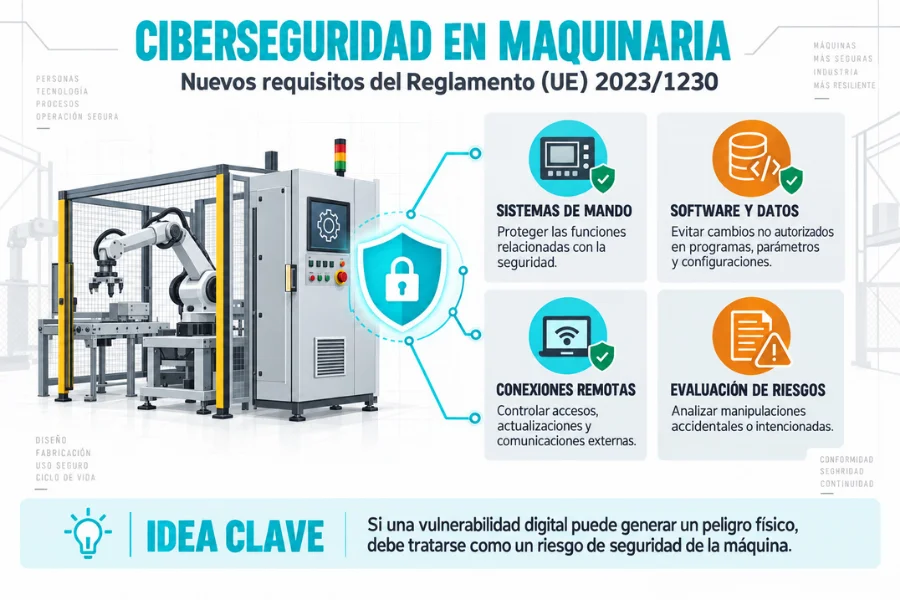
Cybersecurity is part of machine security when a digital alteration can cause physical danger. The goal is not only to protect data, but to prevent accidental or intentional intervention from changing the secure behavior of the equipment.
Some examples are:
- Remotely modify the speed limits or force limits of a robot.
- Change parameters associated with a security function.
- Installing an update that is incompatible with the validated configuration.
- Disable safeguards, locks, or protection devices using software.
- Accessing without authorization the control system of a connected machine.
- Manipulating the data used by sensors or safety-related functions.
The Regulation requires protection against corruption and that connections do not create dangerous situations. Manufacturers and integrators must control versions, access, and updates, as well as retain evidence of interventions that may affect compliance. These measures must be integrated into the risk assessment.
Artificial intelligence and machines with autonomous behavior
The Regulation envisages systems with total or partially self-evolving behavior through machine learning. What matters is not that a machine is advertised as «intelligent», but that its behavior can change and affect safety. This could be the case for mobile robots, vision systems, or equipment that adjust their trajectories or speeds based on new data.
The evaluation must consider the initial behavior and the behavior that may develop subsequently. The manufacturer must set limits, prevent the parameters from exceeding the safety limits, and document the validations.
However, using artificial intelligence does not automatically mean that the machine needs a notified body. The procedure will depend on the category of the product and, especially, on whether the self-evolving behavior guarantees safety functions.
What is a substantial modification of a machine?
One of the most relevant innovations is the definition of Substantial modification. The Regulation links it to a physical or digital modification made after the machine has been placed on the market or put into service, which was not foreseen or planned by the manufacturer and which affects its safety.
For this consideration to be given, the change must create a new danger or increase an existing risk in a way that is necessary:
- Add safeguards or protective devices whose incorporation requires modifying the safety-related control system; or
- Adopting additional protective measures to ensure stability or mechanical resistance.
Changes in speed, capacity, intended use, automation, or security logic may require this analysis. Not all interventions are substantial: a repair or equivalent replacement does not automatically convert the equipment into a new machine. The scope must be justified through a risk assessment.
When the modification is substantial, the person or company that makes it is considered a manufacturer for the purposes of the Regulation with respect to the modified machine. This may involve carrying out a new conformity assessment, preparing or updating the technical file, issuing an EU declaration of conformity and affixing the corresponding CE marking.
Instructions and Documentation in Digital Format
The new Regulation allows for facilitating instructions in digital format. To do this, the manufacturer must clearly indicate how to access them and provide a format that allows them to be downloaded, saved, and printed.
Digital instructions must remain accessible throughout the expected lifespan of the machine and, at least for ten years after its introduction to the market. Furthermore, when the buyer requests a paper copy at the time of purchase, the manufacturer must provide it free of charge within a maximum of one month.
In machines intended for non-professional users, or that can reasonably be used by them, the essential information for their commissioning and safe use must be provided in paper form. The manual will still have to correspond to the actual configuration, be in the required language and be linked to the specific version of the machine.
Machines with higher risk and notified bodies
Annex I establishes categories subject to specific procedures:
- Part A: does not allow the use exclusively of the internal control of production. The evaluation must follow one of the procedures provided for with the intervention of a notified body.
- Part B: It can accept internal control of the Production when the machine has been designed and manufactured in full compliance with harmonized standards or common specifications that cover all relevant essential requirements. If this condition is not met, another applicable procedure must be used.
Not all machines will require external intervention. First, the product must be classified and the applicable procedure verified. A voluntary «CE Certificate» does not replace the EU declaration of conformity, the technical dossier, or the regulatory intervention of a notified body.
Responsibilities of manufacturers, importers and integrators
Responsibilities of manufacturers, importers and integrators
The manufacturer must carry out the risk assessment, prepare the technical dossier, apply the corresponding procedure, prepare the instructions, issue the EU declaration of conformity and affix the CE marking. They must also monitor the software, updates and access points that could affect safety.
Importers and distributors
The importer must verify that the manufacturer has carried out the appropriate assessment, that technical documentation exists and that the machine incorporates the required markings, identification and instructions. Importers and distributors must not market it if they have reason to believe that it is not compliant and must ensure its traceability.
Integrators and companies that modify machinery
When assembling teams that function as a unit, it must be examined whether a set of machines has been created. Individual statements may be insufficient if the integration creates risks or there is a common command system. Those who modify teams must also check whether there is substantial modification.
Does it affect The regulation for machines that are already in operation?
The Regulation does not require existing machines to be re-marked CE. A device that has been legally placed on the market before January 20, 2027, does not lose its conformity due to the regulatory change. The situation changes when a new machine is introduced after that date or a substantial modification is made.
The user company will remain obligated to maintain its equipment in safe conditions in accordance with the Royal Decree 1215/1997. The CE marking mainly regulates marketing and commissioning; RD 1215/1997 regulates safe use. These are related obligations, but not equivalent.
When a machine exhibits deficiencies in its actual working environment, it may be necessary to adaptation of machinery to RD 1215/1997, Although it bears the CE mark.
Checklist to prepare before 2027
| Verification | Question that the company should ask | Recommended action |
|---|---|---|
| Date | When will it be introduced or put into service? | Apply the corresponding framework from the design. |
| Classification | Is it included in Annex I? | Confirm the conformity procedure. |
| Notified body | Is internal control acceptable? | Contact him/her in advance. |
| Risks | Are all uses and phases considered? | Apply the UNE-EN ISO 12100 methodology. |
| Cybersecurity | Would a digital alteration affect security? | Protect access, software, and updates. |
| Autonomy | Can the system modify its behavior? | Defining limits and validation tests. |
| Software | Is it identified by versions? | Documenting configuration and changes. |
| Instructions | Will they be delivered digitally? | Guarantee access and preservation. |
| Importation | Is the manufacturer outside the EU? | Reviewing documentation and obligations. |
| Integration | Do the teams function as a unit? | Evaluate the whole system and its risks. |
| Modifications | Is there a new danger or is there a greater risk? | Analyze whether the modification is substantial. |
Risks of not preparing for the new Regulation
Late checking of connectivity, software or autonomous behaviors may force a redesign of the control system or limit functionality. An incomplete evaluation, a manual that does not match the software or an incorrect declaration can also prevent compliance from being justified. Furthermore, late classification may require testing or the unforeseen intervention of a notified body and delay production.
What companies should do from now on
- Identify the projects that will be commercialized or put into service during 2027.
- Determine the legislation applicable to each machine or assembly.
- Review the product classification and the required evaluation procedure.
- Update the risk assessment methodology.
- Incorporate the risks derived from cybersecurity, software, and remote connections.
- Analyze autonomous or self-evolving functions.
- Review the responsibilities agreed upon with manufacturers, suppliers, and integrators.
- Update technical records, statements and manuals.
- Establish a procedure to evaluate modifications to existing machinery.
- Conduct a final review of the real machine before it is put into service.
A risk assessment in accordance with UNE-EN ISO 12100 It allows to structure this analysis and justify the risk reduction measures.
How Your company can prepare for the Machinery Regulation 2027
The transition to Regulation (EU) 2023/1230 should begin during design and not when the machine is already finished. Properly classifying the equipment, defining responsibilities, and reviewing mechanical, electrical, and digital risks from the outset reduce late modifications and facilitate commissioning.
At Grupo TICE Ingenieros, we help manufacturers, importers and integrators determine the applicable regulations, assess risks, review assemblies, analyze substantial modifications, and prepare the necessary documentation for the marked CE of machinery.
If your company manufactures, imports, integrates or modifies machinery that will be put into service from 2027 onwards, we can help you review the project and anticipate the requirements of the new Machinery Regulation.
Frequently asked questions about the new Machinery Regulation
In general terms, on January 20, 2027. Until then, Directive 2006/42/EC will continue to apply.
Yes. It replaces it and will be directly applicable in all Member States.
Not just because of the regulatory change. A modification that could be substantial will have to be reviewed.
Manufacturing alone does not determine the standard. It must be verified when it is introduced into the market or, where appropriate, when it is put into service for the first time.
It is a physical or digital change not foreseen by the manufacturer that affects safety and meets the criteria established by the Regulations.
No. It depends on your category and the applicable procedure. The categories of Part A of Annex I do require your intervention.
Yes, if their access, download and storage are guaranteed. The buyer can request a paper copy when making the purchase and there are special requirements for non-professional users.
It must be protected against access or alterations that could affect its safe operation.
It requires evaluating systems with self-evolving behavior, especially when they are involved in security functions.
The Regulation regulates the conformity of the product; RD 1215/1997, the
safe use of work equipment.
It must be determined whether the result constitutes a set of machines and who assumes responsibility for its integration and compliance.
It must verify the manufacturer, the EU declaration of conformity, the marking, the instructions, the documentation correspondence and the procedure applied, in addition to fulfilling its obligations as an importer.