
Robotic Applications

Robotic Applications Engineering for Industrial Lines and Processes

Industrial Automation and Electrical Experts

At Grupo TICE, we specialise in industrial robotic applications, with a technical focus aimed at improving productivity, flexibility, and safety in manufacturing environments. We design new applications, upgrade existing cells, and adapt robotic systems so that your plant can evolve with changes in process, product, or production capacity, all while maintaining stable and controlled performance.

We have a multidisciplinary engineering team that works with rigour, coordination and a global vision, understanding the real context of each installation. Our objective is to provide solid and sustainable solutions, with methodology, precise documentation and careful execution, so that each project generates value and reinforces the competitiveness of your industrial environment.
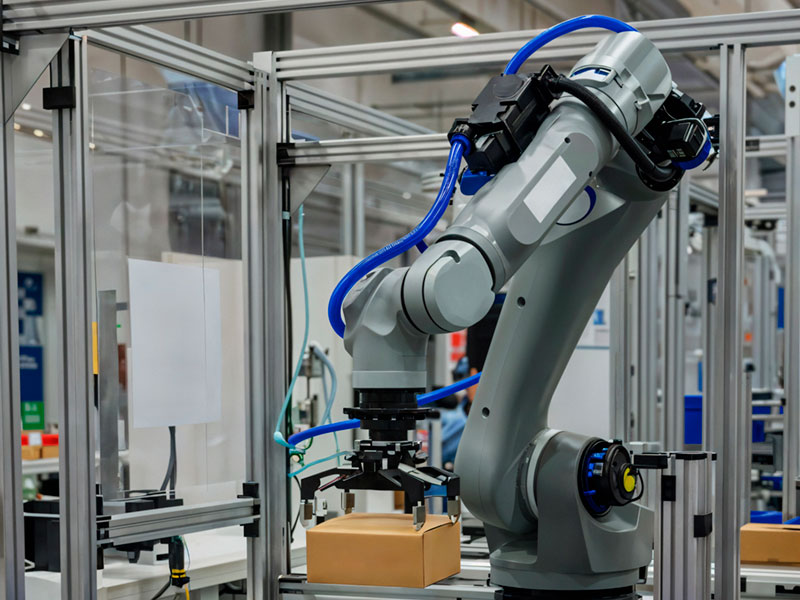

Industrial Robotic Applications Services on Site

At Grupo TICE, we develop and evolve industrial robotics solutions focused on performance, flexibility, and operational continuity. We work on existing cells and new developments, integrating the robotic system with the process to achieve stable and measurable results.

Upgrade of Existing Robotic Cells.

We optimise and update installations to improve reliability, safety, and productivity without unnecessarily replacing assets.

Implementation of New Robotic Applications.

We design and implement new cells adapted to your process, with industrial criteria and a maintainable approach.

Adaptation of Robots to New Processes or References.

We adjust the robotic solution for product changes, tooling, or sequences, maintaining quality and cycle stability.

Improving Flexibility and Reusability of Assets.

We prepare the cell for changes and expansions, maximising the utilisation of equipment and reducing evolution costs.

Integration of Robotics with Process Control and Artificial Vision.

We connect robots, controls, and inspection systems to ensure operational consistency, quality control, and traceability when required.

Retrofit for Robotic Applications

Industrial Robotic Retrofitting involves upgrading or modernising existing industrial robots with new technology, components, or software. This can include replacing outdated hardware, updating control systems, adding advanced sensors, or integrating new functionalities to improve performance, efficiency, safety, or extend the operational lifespan of the robot. Essentially, it's about bringing older robots up to contemporary standards without the need for a complete replacement.

At Grupo TICE, we develop retrofit projects for industrial robotic applications aimed at updating existing facilities and giving them a second life. We are coordinating the adaptation of the mechanical, electrical, and control components to restore reliability, enhance safety, and ensure stable production performance.


Each retrofit is defined according to the production process, the actual state of the robotic system and the client's operational objectives. This way, it's possible to reuse industrial robots and control systems, ensuring stable, repeatable, and easily maintainable solutions over time.

Industrial Robotic Retrofitting Services

At Grupo TICE, we develop robotic retrofits to update existing applications and adapt them to the current production reality. The objective is to improve performance, flexibility, and maintainability, integrating the robot with the necessary control and peripherals for stable operation.

Updating Existing Robotic Applications

We reviewed and adjusted the solution to regain reliability and adapt it to the plant's current needs.

Reprogramming and Optimisation of Movements and Sequences

We refine trajectories and working logic to improve cycle times, repeatability, and operational smoothness.

Adaptation of the Robot to New Processes or References

We adjust the cell for product, tooling, or sequence changes, maintaining quality and production stability.

Integration with Control Systems, Peripherals, and Artificial Vision

We ensure coherent integration with PLCs/HMIs, safety systems, sensors, and vision for complete process control and traceability where applicable.

Improvement of Functional Safety and System Diagnostics

We are strengthening security and diagnostic functions to simplify maintenance, reduce incidents, and increase the cell's availability.

If your Robotic Cell has become obsolete, modernise it with our Robotic Retrofit.

Flex-Cells Robotic

Flexible and Adaptable Robotic Cells

Grupo TICE's flexible robotic cells are designed to automate industrial processes with a high degree of flexibility, allowing adaptation to changes in product, process, or production volume without needing to redesign the installation.

We develop robotic Flex-Cells as modular and scalable solutions, ready for integration into existing production environments and for evolving according to the actual needs of the plant. This approach facilitates expansion, asset reuse, and continuous performance improvement, while maintaining operational stability and coherent integration with the process.

Common Applications in Robotic Flex-Cells

TICE Group's Robotic Flex-Cells adapt to different industrial processes thanks to their flexible and modular approach. Here are some of the most common applications, organised by type, to quickly understand where they add the most value in production.

Industrial Robotic Manipulation

Pick and Place.

Automation of repetitive movements to improve workflow cadence, accuracy, and stability.

Loading and Unloading of Machinery.

Feeding and removal of parts with constant times, reducing waiting times and improving equipment availability.

Interprocess Communication.

Efficient connection between stations to ensure operational continuity and minimise manual handling.

Automated Industrial Processes with Robotics

Screw-mounted.

Repeatable and controlled execution to improve consistency and reduce deviations in assembly

Drilling.

Automated operation with precision and repeatability, suitable for demanding production runs and paces.

Threaded.

Stable process with cycle control to improve quality and reduce rework.

Application of glues and adhesives.

Uniform and traceable dosing, maintaining consistent quality and reducing material waste.

Sharpened.

Automation of finishing tasks to achieve consistency, safety, and stability in the final result.

Machine Vision Inspection in Industrial Robotics

Quality control.

Automated inspection for defect detection and to ensure consistent quality criteria.

Process Verification.

Confirmation of operations and parameters to reduce errors and reinforce traceability.

Presence / Absence.

Validation of components and positions to avoid assembly failures and subsequent incident stoppages.

Characteristics of TICE Group's Robotic Flex-Cells

Grupo TICE's Robotic Flex-Cells are designed to provide real on-site flexibility, facilitating reference changes and process evolution without needing to redo the installation. The modular approach allows for the integration of control, safety, and tooling with a technical base prepared for growth.

Modular and Reconfigurable Architecture.

A structure designed to adapt the cell to new needs, simplifying changes and reducing adaptation times.

Integration of Industrial Robots, Control Systems, and Machine Vision.

Complete coordination between robot and automation for stable operation, with verification and traceability when the process requires it.

Interchangeable Tooling by Process.

Preparation for changing tools and settings in an orderly manner, maintaining repeatability and production consistency.

Application-Specific Security Systems.

Security designed according to risk and operations, guaranteeing a controlled working environment consistent with the facility.

Ready for future expansions or process changes.

Scalable base for incorporating new functions, stations or equipment, maintaining solid and maintainable integration in the long term.

Regulations and Verification Approach in Industrial Robot Applications

At Grupo TICE, we apply a rigorous approach to regulatory compliance and verification in industrial robotics projects, adjusting requirements to the actual scope of the cell and its integration into the plant. The objective is to ensure safe, reliable, and auditable systems, reducing risks and facilitating operation and maintenance. Depending on the project, we work under the following frameworks:

ISO 10218-1 / ISO 10218-2.

We align the cell design and integration with specific safety requirements for industrial robots, ensuring an implementation that is consistent with the application and working environment.

ISO 13849-1.

We define and verify safety functions when applicable, ensuring that the control architecture and components respond to the required reliability level.

IEC 60204-1.

We apply the criteria for electrical equipment of machines to ensure safe integration of the electrical and control system, with appropriate protections and design for industrial operation.

Machinery Directive 2006/42/EC.

When robotic applications affect safety functions or represent a significant modification, we evaluate the impact to ensure compliance, technical traceability, and secure integration into the installation.

If you want to automate with an adaptable and scalable cell, request a Flex-Cell.

Benefits of Industrial Robotic Applications with Grupo TICE

The industrial robotic applications developed by TICE Group bring direct value to production when seeking to improve productivity, adaptability, and process control. By designing, updating or adapting robotic solutions with an industrial engineering approach, the plant gains operational stability, makes better use of its assets, and enhances safety and technological integration.

Operational Optimisation and Productivity.

Automation through industrial robotics improves process repeatability and efficiency, stabilises cycle times, and reduces variability, driving more consistent production output.

Second Life for Assets.

Upgrading existing cells and adapting robots to new requirements allows for the reuse of equipment and extends its lifespan, reducing unnecessary investment and maintaining production capacity with guarantees.

Security and Regulatory Compliance.

A well-defined and integrated robotic application enhances operational safety, ensures compliance with applicable requirements, and provides technical traceability for audits, maintenance, and future development.

Advanced Technological Integration.

Integration with process control, peripherals, and machine vision enhances system control, facilitates clear diagnostics, and allows for the incorporation of verification, quality, and traceability when the process requires it.

Industrial Robotic Applications: Experience and Technical Guarantee

At Grupo TICE, we have a consolidated track record of over 20 years in industrial robotics projects, working on both new implementations and the updating and adaptation of existing cells in real production environments. Our industrial engineering team approaches each application with a global vision, considering process, integration, safety, and operation to ensure consistent results.

We apply technical criteria focused on reliability and maintainability, carefully defining the scope, integration with control systems and peripherals, and on-site validation. This allows us to obtain stable, repeatable solutions that are prepared to evolve when references, speeds, or quality requirements change.

Our technical guarantee is underpinned by rigorous execution, final verification and complete documentation, offering customer support throughout the project and in the subsequent evolution of the installation.

Years of Experience
+ 0
Projects Completed
+ 0
Satisfied Customers
+ 0

Industrial Robotic Applications Working Methodology

In TIC GroupWe follow a structured methodology for developing industrial robotic applications with guarantees of performance, safety, and integration. This approach allows us to design new applications, update existing cells, and adapt robotic systems to changes in process or production capacity, ensuring scalable solutions that are aligned with the plant's reality.

Process and Objectives Analysis.

We studied the production process, the product and the installation's constraints (space, cycle times, quality, references, and operations). With this basis, we defined measurable objectives and the project's technical scope.

1
Preliminary Design of the Robotic Cell.

We are proposing the solution at the cell level: robot, peripherals, parts flow, layout, tooling, and integration requirements. We prioritise flexibility and asset reuse when the project requires it.

2
Integration with Control and Security.

We developed the automation, signalling, communications and functional safety architecture, defining the verification requirements and the system's operation and maintenance criteria.

3
Development, Programming and Testing.

We program and optimise trajectories, sequences and work logic, preparing the system for repeatable behaviour. Where applicable, we integrate machine vision and inspection criteria aligned with the process.

4
Assembly, Installation and Commissioning.

We are carrying out the integration in the live environment, making cycle adjustments, coordinating with peripherals, and performing safety checks. We are validating the operation to ensure operational stability and performance aligned with the objective.

5
Final Validation, Documentation, and Support.

We will deliver the project's technical documentation and leave the system ready for operation and maintenance. We will support the client after implementation with ongoing service, adjustments, and future development as processes or references change.

6

Industrial Robotic Applications, Improve your Plant's Productivity, Flexibility and Control.

FAQs About Our Industrial Robotics Service

Various processes in a production line can be automated with industrial robotics, including:* **Assembly:** Robots can perform repetitive and precise assembly tasks, such as placing components, screwing, welding, and soldering. * **Material handling:** This includes loading and unloading machines, palletising, de-palletising, and transferring parts between workstations. * **Welding:** Robots are widely used for arc welding, spot welding, and laser welding, ensuring consistent quality and speed. * **Painting and coating:** Robots can apply paint, powder coating, or other surface treatments with high precision, leading to uniform finishes and reduced waste. * **Machine tending:** Robots can load and unload raw materials into machines (like CNC machines or injection moulding machines) and remove finished parts. * **Inspection and quality control:** Robots can be equipped with sensors, cameras, or other inspection tools to examine products for defects, ensuring quality standards are met. * **Packaging:** Robots can pick and place products into boxes, cartons, or other packaging, as well as seal and label them. * **Cutting and machining:** Robots can perform cutting (e.g., waterjet, plasma) or machining operations on materials with high accuracy. * **Screwing and fastening:** Robots can precisely drive screws, nuts, and bolts, ensuring proper torque and placement. * **Palletising and de-palletising:** Robots can efficiently stack or unstack products onto pallets for shipping or storage.

In a production line, industrial robotics can automate operations where repetitiveness, constant pace, and process control are required, especially in end-of-line tasks, advanced manipulation, and integration with manufacturing stations. It is common to automate palletising and depalletising, case packing and packaging, line feeding, and internal logistics between stations, as well as joining and finishing operations such as welding, sealant application, polishing/sanding, or handling of complex geometric parts. Furthermore, robotics is increasingly integrated with control and data capture systems to enhance production stability, quality, and traceability.

When is it advisable to implement an industrial robotics application in production?

It is advisable to implement an industrial robotic application when the process requires stability, repeatability, and production capacity with a consistent level of quality, and when manual operation begins to limit performance or generate variability. It is usually the right time if there are bottlenecks slowing down the line, if the position requires maintaining a high pace for long shifts, or if the task involves ergonomic and safety risks that need to be better controlled. It is also recommended when the company seeks to standardise quality, reduce rework, and have a more controlled and measurable process. In these cases, a well-defined robotic implementation allows for increased productivity and ensures consistent production results.

What maintenance does a robotic cell require?

The maintenance of a robotic cell depends heavily on its configuration (robot, tooling, grippers, external axes, pneumatics, guarding, etc.), but in general, it is based on ensuring mechanical availability and system stability. It usually includes periodic checks for lubrication, clearances and wear, inspection of gearboxes, moving cables and connectors, condition of hoses and pneumatic components, tooling adjustments, cleaning in sensitive areas, and verification of calibrations when the process requires it. It is also important to review backups and versions to keep the system under control.

At Grupo TICE, we will inform you of the tasks corresponding to your cell, with realistic periodicity according to usage and environment. Contact us and we will define it with you based on your installation.

How is the commissioning and validation of a robotic cell carried out in a plant?

The commissioning and validation of a robotic cell on-site is carried out with a progressive approach, to ensure that the system achieves performance and safety without generating uncertainty in production. First, the installation and consistency between the robot, peripherals, and control (signals, communications, tooling, and operating conditions) are checked. Afterwards, trajectories, speeds, and process parameters are adjusted under real conditions, verifying that the cell works stably and repeatably.

Validation is completed by comparing cycle times, quality criteria, stoppage management and incident recovery, in addition to applicable safety checks. Once the agreed criteria are met, the system is left ready for operation with controlled records and configuration.

When is it worth retrofitting a robotic cell instead of replacing it?

It is worth undertaking an industrial robotic retrofit when the mechanical base and cell structure are still valid, but the system begins to limit production due to obsolescence, unreliability, or a lack of spare parts. In such a scenario, upgrading the cell allows for the recovery of performance and the reduction of risks without facing the impact of a complete replacement.

It is usually a good decision if the robot and mechanics are in good condition, if the layout already fits the plant, and if the objective is to improve cycle times, stability, safety, or diagnostic capabilities to keep operations under control. It is also particularly recommended when the cell needs to be adapted to new production demands, and it is advisable to do so with a planned and validated intervention.

If you share with us the status of your cell (make/model, year, process, and main issues), at Grupo TICE we can tell you if a retrofit or replacement is worthwhile and what the most efficient scope would be.

How does a retrofit affect regulatory compliance and functional safety?

A robotic retrofit can affect regulatory compliance and functional safety because, in practice, it introduces changes to elements that influence how the cell behaves and how risk is managed.

At Grupo TICE, we approach this with a clear criterion: assess the impact of the modification before carrying it out and verify afterwards that the cell maintains an adequate safety level. This involves reviewing which safety functions are affected, checking that the architecture and devices continue to fulfil their purpose, and documenting the technical traceability of the change.

If you are considering a robotic retrofit, please contact us and we will review the scope to define which checks and documentation are necessary in your case.

What is the difference between a Flex-Cell and a standard robotic cell?

The main difference lies in the design objective. A standard robotic cell is usually conceived for a specific task and a fairly fixed configuration: it works very well within a defined range, but significant changes usually require re-engineering, reprogramming, and more impactful tooling adjustments.

A Flex-Cell is designed from the outset to adapt to production changes, prioritising a reconfigurable architecture, clear interfaces, interchangeable tooling, and integration prepared to absorb new product lines or process adjustments with reduced adaptation time. In summary, a standard cell optimises a specific scenario; a Flex-Cell optimises the ability to evolve while maintaining operational stability and control.

What are the typical timescales for the design and implementation of a flexible robotic cell?

The design and implementation timescales for a flexible robotic cell depend on the scope and level of integration: process complexity, number of product variants, tooling, peripherals, safety requirements, and on-site commissioning conditions. Therefore, to provide a reliable timescale, it is necessary to review the actual production context and the available intervention windows.

If you describe your application or share basic information about the line with us, at Grupo TICE we will provide you with an estimated timeline and an implementation plan tailored to your project.

What is the price of an industrial robotics project?

The price of an industrial robotics project depends on the scope and how it needs to be integrated into your production. There isn't a single figure because key factors influence it, such as the type of application, the target cycle time, the number of references, the necessary tooling and peripherals, the level of safety required, integration with plant control, and, if applicable, the incorporation of artificial vision or traceability.

At Grupo TICE, we provide estimates based on clear technical criteria: we define the scope, identify implementation constraints, and specify deliverables and on-site validation so that the investment is coherent and justifiable.

If you share your process with us, we will prepare a technical assessment and an economic proposal tailored to your plant.

Why is it important to hire a company specialising in industrial robotics?

Hiring a specialist industrial robotics company is important because a robotic application must fit in with the production process, quality criteria, safety regulations and the plant's daily operations. When all these elements are designed and integrated judiciously, the result is a stable, repeatable and easy-to-maintain solution.

At Grupo TICE, we provide confidence for three reasons: experience in real industrial environments, a multidisciplinary engineering team (mechanical, electrical, control, and integration), and a working method based on methodology, verification, and documentation. This ensures well-defined projects, solid implementations, and systems prepared to evolve with guarantees.

If you wish, tell us about your application and we'll guide you on the most suitable approach for your case.

Contact Us

Put your project of Robotic Applications In the hands of specialists.

Contact our technical team and we will guide you to the most suitable solution.