
ISO 12100

Machinery Risk Assessment according to ISO 12100

Identify, Analyse, and Control your Equipment's Risks to ensure Safety and Regulatory Compliance.

Machinery Risk Assessment according to UNE-EN ISO 12100

At Grupo TICE Ingenieros, we specialise in the risk assessment of machinery in accordance with UNE-EN ISO 12100, an international standard for identifying hazards and defining risk reduction measures for industrial equipment. Our team of engineers rigorously analyses each machine technically, evaluating its design, its interaction with operators, and its operating environment, to ensure safe operation that complies with current regulations.

Thanks to our multi-sector experience, we offer accurate assessments, practical solutions, and comprehensive technical documentation, making us a reliable ally for companies seeking safety, legal compliance, and continuous improvement in their facilities.

What is UNE-EN ISO 12100?

The UNE-EN ISO 12100 is the international standard that establishes the framework for identifying hazards, assessing the risks associated with a machine, and defining the necessary measures to reduce them to acceptable levels. Its objective is to ensure that any industrial equipment can be used safely throughout its entire life cycle, from initial design to daily use on the plant floor.

At Grupo TICE Ingenieros, we apply this methodology to systematically analyse the mechanical, electrical, thermal, ergonomic, and functional hazards that can affect the operator or the work environment. Based on this assessment, we determine the probability and severity of each risk and propose technical solutions that allow for their elimination or reduction through design measures, guards, control systems, operating procedures, or user information.

Risk assessment according to ISO 12100 is an essential tool for both manufacturers and users of industrial machinery, as it allows for the demonstration of regulatory compliance, accident prevention, and the establishment of a consistent and verifiable level of safety throughout the installation.

What our service includes
Risk Assessment according to ISO 12100

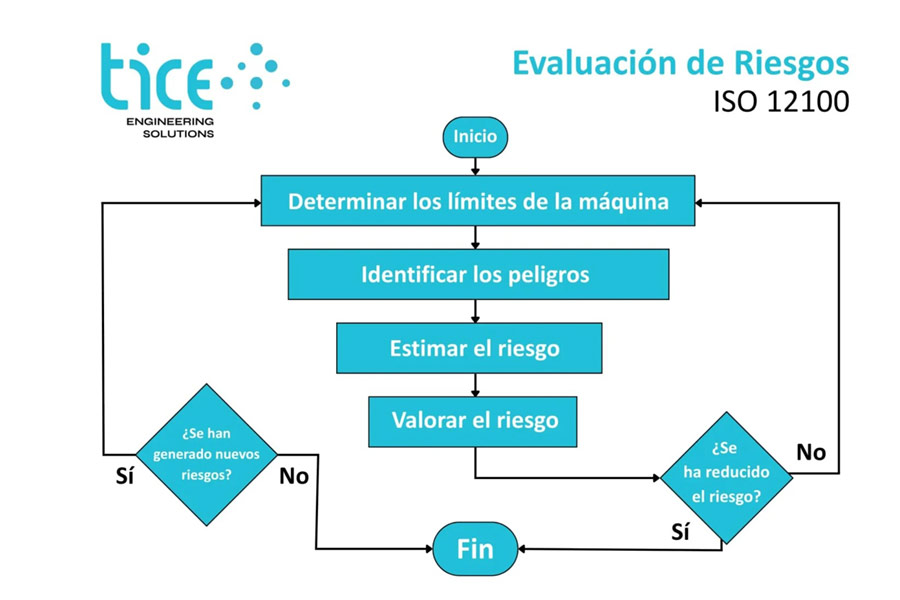
Our risk assessment service, compliant with UNE-EN ISO 12100, covers all necessary stages to identify hazards, evaluate associated risks, and define measures that ensure safe use of machinery. At Grupo TICE Ingenieros, we follow a structured methodology that allows for a complete, traceable analysis aligned with the regulatory and operational requirements of each company.

Technical Analysis of the Machine and its Functions

We study the equipment design, its mode of operation, and the interaction between operators, environment, and machinery to detect potentially dangerous situations under normal and foreseeable conditions of use.

Hazard Identification according to UNE-EN ISO 12100

We reviewed the mechanical, electrical, thermal, and ergonomic hazards, as well as those associated with control failures, considering all elements that could generate risk during the machine's operation, maintenance, or intervention.

Risk Estimation and Evaluation

We assess the potential severity of the harm, the frequency of exposure, and the possibility of avoiding the risk, determining the level of risk associated with each hazard and establishing implementation priorities.

Definition of Mitigation and Protection Measures

We propose design solutions, control systems, guards, signage, and organisational measures to eliminate or reduce identified risks to acceptable levels, in accordance with ISO 12100.

Implementation and Validation of Measures Verification.

We check that the proposed reduction measures have been applied correctly and that they work as intended, validating safeguards, interlocks and usage conditions to ensure coherence between the analysis and the reality of the machine.

Technical Documentation and Assessment Registration

We have produced a comprehensive report that includes hazard analysis, a risk tree, measures implemented, additional recommendations, and all necessary documentation to demonstrate correct application of the standard.

Do you need a Risk Assessment according to ISO 12100? We can help.

According to ISO 12100, a risk assessment should be performed when designing new machinery, when modifying existing machinery, or when carrying out maintenance on machinery.

Risk assessment is not a one-off procedure, but a process that must be applied at key moments to ensure that machinery operates with an adequate level of safety. At Grupo TICE Ingenieros, we help to determine the exact moment when a company should re-evaluate its equipment to avoid non-compliance with regulations and ensure reliable operation.

During the acquisition or design of new machinery.

This allows security to be integrated from the outset, anticipating risks and defining technical solutions before manufacturing or installing the equipment. This avoids subsequent redesigns, reduces costs, and ensures that the machine is manufactured in compliance with applicable regulations.

Before the commissioning of an existing Machine.

Ensure that the machine complies with RD 1215/1997 and other legal requirements before starting operation. This pre-operational check allows for the detection of deficiencies, their correction in advance, and guarantees safe use from the very first day of operation.

When Processes are modified or new Systems are added.

Any changes to the production process, the addition of peripherals, or equipment upgrades can alter the machine's behaviour and generate new risks. Re-evaluation ensures that the assembly remains safe after any relevant modification.

After an Accident or Incident.

A post-incident review allows for the identification of the root cause, a review of the involved safety systems, and the implementation of effective corrective measures. This analysis provides critical information to prevent recurrences and strengthen the protection of operators in future operational scenarios.

In Periodic Safety Reviews.

Reviewing annually or following significant changes ensures the machine remains aligned with safety standards. This regularity allows for the detection of wear, deviations, or emerging faults, keeping the installation in optimal condition and complying with current regulations.

Benefits of a Risk Assessment according to ISO 12100

Carrying out a risk assessment in accordance with UNE-EN ISO 12100 allows companies to industrialise safety, anticipate problems and ensure that each machine operates under verifiable technical criteria. At Grupo TICE Ingenieros, this assessment becomes a strategic tool that improves personnel protection, process efficiency and the documentary integrity of the installation.

Proactive Accident Prevention.

It allows risks to be identified and controlled before incidents occur, reinforcing operator safety and preventing critical situations in the plant.

Reduction in the probability of failure or accident.

The proposed corrective measures reduce the frequency and severity of incidents, improving the stability and reliability of the equipment in daily use.

Full Machine Lifecycle Coverage.

We assess risks from design to decommissioning, ensuring that each phase of the lifecycle has adequate safety measures in place.

Technical and Legal Documentation Generation.

A detailed, traceable and auditable report is created, which can be used as a basis for subsequent processes such as compliance with RD 1215/1997 or CE marking.

Regulatory Compliance and Support during Inspections.

The company can prove that its machines have been assessed according to an international standard, avoiding penalties and facilitating internal or external audits.

Technical Experience and Warranty in Risk Assessment according to ISO 12100

With over 20 years of industrial engineering experience, at Grupo TICE Ingenieros we apply the UNE-EN ISO 12100 methodology to machinery across a wide variety of sectors: automotive, logistics, chemical industry, plastics, pharmaceutical, food, ceramics, and production environments with high technical demands. This multi-sectoral background allows us to interpret how machinery behaves in each real operational context and adapt risk assessments to the specific conditions of each plant.

Our studies are distinguished by technical precision, diagnostic capability, and the creation of fully traceable documentation, ensuring that each assessment meets regulatory requirements and provides effective and applicable risk reduction measures. Thanks to this expertise, we offer a reliable, robust service that is perfectly aligned with the security needs of any industrial environment.

Years of Experience
+ 0
Evaluations Carried Out
+ 0
Reports Issued
+ 0
Advised Companies
+ 0

Working Methodology in Risk Assessment according to ISO 12100

At Grupo TICE Ingenieros, we apply a structured work process that guarantees each machine is evaluated, adapted, and certified with technical rigour and full traceability. Our methodology combines auditing, engineering, and verification to ensure compliance with Royal Decree 1215/1997 is carried out completely, efficiently, and with proper documentation.

Initial Technical Audit.

We assess the real state of the machine, its environment, and its usage mode to identify risks, deficiencies, and compliance requirements according to Royal Decree 1215/1997.

1
Risk Analysis and Proposals.

We carried out a detailed hazard study and determined the necessary corrective measures to achieve the safety conditions required by the regulations.

2
Design and Implementation of Corrective Measures.

We develop the necessary technical solutions, protections, electrical improvements, control systems, signalling and safeguards, and implement each element with safety and operational criteria.

3
Technical Validation and Documentation.

We verify that all implemented measures comply with regulations and prepare the documentation that proves their suitability, including reports, plans, and technical records.

4
Certification and Final Delivery.

We issue the certificate of conformity with RD 1215/1997, noting regulatory compliance and guaranteeing that the machine can be used safely within the plant.

5

Identify Risks and Avoid Sanctions, Talk to Experts in ISO 12100.

FAQs on Risk Assessment according to UNE-EN ISO 12100

Is risk assessment mandatory according to the UNE-EN ISO 12100 standard?

Yes. Risk assessment is both a legal and technical obligation for machinery manufacturers and companies that use industrial equipment. UNE-EN ISO 12100 is the internationally recognised methodology for identifying hazards and defining risk reduction measures, making its application essential to guarantee the safety of any machine.

Furthermore, Royal Decree 1215/1997 requires employers to ensure that all work equipment used in the company is safe and has documented assessments to prove it. Without this analysis, it is not possible to demonstrate regulatory compliance or guarantee the protection of workers against the risks associated with machinery.

What is the difference between an ISO 12100 risk assessment and compliance with RD 1215/1997 concerning machinery?

Risk assessment according to ISO 12100 is a technical analysis whose objective is to identify hazards present in a machine, estimate the level of risk, and define the necessary measures to ensure its safety. This study establishes the required level of protection, but does not imply the implementation of improvements.

The adaptation of machinery to RD 1215/1997, conversely, is the process by which these measures are executed: installation of guards, incorporation of safety systems, documentary update, and certification of legal compliance. It is the step that allows demonstrating that the machine can be used safely in the workplace according to Spanish legislation.

In summary

  • Risk assessment detects and analyses hazards.

  • Compliance with Royal Decree 1215/1997 implements solutions and certifies regulatory compliance.

Does risk assessment according to ISO 12100 serve as a basis for the CE marking of machinery?

Yes. The risk assessment carried out in accordance with UNE-EN ISO 12100 is one of the main and mandatory elements within the CE marking process for machinery. This assessment allows the manufacturer to identify all hazards associated with the equipment, estimate the risks, and define the necessary measures to ensure that the machine complies with the essential safety requirements established by European legislation.

The resulting report forms part of the machine's technical documentation, along with drawings, design documentation, instruction manuals, and the EC Declaration of Conformity. Without this assessment, the manufacturer cannot justify the product's conformity or affix CE marking prior to its marketing in the European Union.

Does ISO 12100 risk assessment also apply to old machinery or only to new machines?

Risk assessment according to UNE-EN ISO 12100 applies to all types of machinery, regardless of their age, origin, or level of automation. It is not a process reserved solely for new machines: it is also essential for old equipment that continues to be part of the production process.

In old machinery, this assessment allows for the identification of safety deficiencies that do not meet current standards and the planning of their adaptation in accordance with Royal Decree 1215/1997, improving operator protection and reducing the likelihood of failures.
In new machinery, the assessment ensures that the design meets the essential safety requirements necessary for CE marking, ensuring a legal and safe commissioning from day one.

Tras una evaluación de riesgos según la norma ISO 12100, Grupo TICE entrega la siguiente documentación:* **Informe de Evaluación de Riesgos:** Este es el documento principal que detalla los riesgos identificados, el análisis de los mismos (probabilidad y severidad) y la priorización según su criticidad. Incluye la metodología utilizada, los estándares de referencia (ISO 12100 y otras relevantes), y las zonas o equipos analizados.* **Justificación de los Riesgos Residuales:** Si no es posible eliminar todos los riesgos por completo, el informe incluirá una explicación de por qué los riesgos residuales son aceptables, basándose en un análisis de la relación coste-beneficio o la aplicación de medidas de reducción de riesgo factibles.* **Propuestas de Medidas de Reducción de Riesgos:** Se presentarán recomendaciones concretas para eliminar o reducir los riesgos identificados a un nivel aceptable. Estas medidas pueden incluir modificaciones en el diseño, la implementación de dispositivos de seguridad, la creación de procedimientos de trabajo, la formación del personal, o el uso de equipos de protección individual (EPI).* **Anexos y Evidencias:** Dependiendo de la complejidad de la evaluación, se pueden incluir anexos con planos, esquemas, fotografías, listas de verificación, resultados de mediciones (si aplica), y cualquier otra evidencia que respalde el análisis realizado.* **Planes de Implementación (Opcional):** En algunos casos, y si así se acuerda con el cliente, Grupo TICE puede proporcionar un plan de implementación para las medidas correctivas sugeridas, detallando las fases, responsables y plazos.Todo este conjunto de documentos está diseñado para proporcionar al cliente una comprensión clara de los riesgos asociados a sus máquinas o equipos y las acciones necesarias para garantizar un entorno de trabajo seguro conforme a la normativa vigente.

Following the evaluation, at TICE Ingenieros Group, we deliver a technical dossier that clearly and verifiably records all the analysis carried out. This document includes the risk report, the evaluation matrix, the proposed reduction measures, and the necessary photographic or schematic record to justify each conclusion.
Furthermore, we incorporate practical recommendations that serve as a basis for future adaptations, internal audits or CE marking processes.
This way, the company has complete, traceable documentation that is valid for inspections or safety reviews.

In a company, the obligation to carry out risk assessment according to ISO 12100 generally falls upon the manufacturer or the person responsible for placing the machinery on the market.

The responsibility for carrying out a risk assessment in accordance with UNE-EN ISO 12100 falls on any entity that designs, manufactures, modifies, or uses machinery in a work environment.
In the case of new machinery, the manufacturer, or their authorised representative, is obliged to carry out this assessment as part of the CE marking process.
In machinery already installed or in use, responsibility passes to the employer, who must guarantee that their equipment is safe and complies with the requirements demanded by RD 1215/1997.
Integrators and companies that modify production lines are also obliged, as any change can alter the risk level of the machinery.
In all cases, this assessment is the technical document that demonstrates that the machine has been reviewed in accordance with a recognised international standard.

Yes, a risk assessment according to ISO 12100 can help avoid penalties during a workplace inspection.

Yes. Having a risk assessment carried out in accordance with UNE-EN ISO 12100 is one of the most important elements during a work inspection. This document demonstrates that the company has identified the hazards of its machinery, has assessed the risks, and has a technical plan to control them, which is considered solid evidence of preventive compliance.

Although the assessment does not replace compliance with Royal Decree 1215/1997, it does allow the company to justify that it has acted with due diligence and knows the necessary measures to guarantee the safety of its equipment. This significantly reduces the probability of sanctions, machinery seizures, or urgent correction requirements.

A well-executed evaluation not only improves safety but also strengthens the company's position in any official review.

How long does a machinery risk assessment according to ISO 12100 take?

The duration of a risk assessment according to UNE-EN ISO 12100 primarily depends on three factors: the complexity of the machine, its current condition, and the number of operating modes that need to be analysed. In general, an assessment can be completed in relatively short timescales when the equipment is well-documented and accessible, whereas older, modified machinery or that with multiple interactions requires a more detailed study.

At TICE Engineers Group, we plan each project individually to adjust timelines and minimise any impact on production. If you would like a more precise estimate, we can evaluate your case and provide you with a timeframe tailored to the characteristics of your machinery and your company's needs.

What is the approximate cost of a risk assessment according to ISO 12100?

The cost of a risk assessment in accordance with UNE-EN ISO 12100 varies depending on the complexity of the machinery, its current condition, the number of functions to be analysed, and the amount of documentation available. Simple equipment usually requires a smaller investment, while old, modified, or multi-operation machinery necessitates a more in-depth analysis and, therefore, a different budget.

At Grupo TICE Ingenieros, we carry out a personalised assessment to ensure that the scope of work precisely matches the needs of each team and company. If you would like an indicative cost, we can analyse your case and provide you with a quote tailored to your machinery and production process.

Contact Us

Put on the Risk Assessment according to ISO 12100 In the hands of specialists.

Contact our technical team and we will guide you to the most suitable solution.