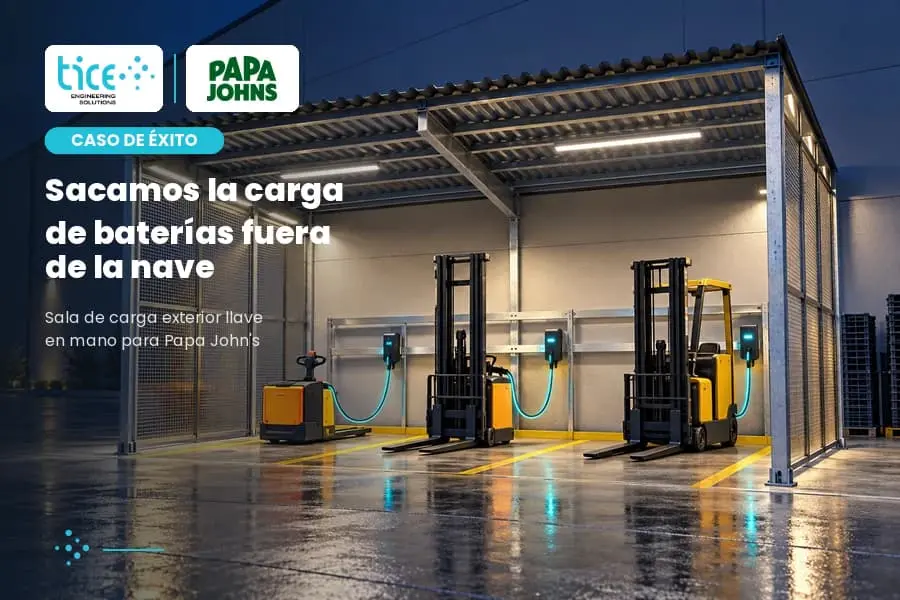
A battery loading bay is a separate area of the ship's operations where forklifts, pallet trucks and electric stackers are charged with adequate ventilation. During charging, lead batteries release hydrogen and acidic vapors. To meet the requirements of its PRL service, Papa John's commissioned us with an external loading bay with natural ventilation, turnkey: design, electrical installation, signposted spaces and documentation.
The result was the PRL requirement fulfilled and space recovered within the ship.
In many industrial and logistics vessels, electric forklifts, pallet trucks and stackers are loaded wherever it is possible: next to a column, at the bottom of a hallway or in a corner of the warehouse. They work… until the Occupational Safety and Health (OSH) service requests a change. That is what happened to Papa John's, and that is how we solved it at Grupo TICE with a battery loading room Exterior, designed and installed turnkey.
Their fleet runs on lead-acid batteries. Their PRL service indicated that they should charge the machines outside the ship, because during charging these batteries can release harmful gases and vapors. The question for many companies was: how do we do it, where and with whom?
Why the loading of lead batteries inside the ship is a risk
The Lead-acid battery charge It is not a neutral operation. During the process, especially in the final loading phase, a chemical reaction occurs that releases gases into the environment.
The two that concern me the most are:
-
Hydrogen. It is a colorless, odorless and flammable gas. When mixed with air, it can form explosive atmospheres at relatively low concentrations (around 4% % by volume). That is why Hydrogen in battery charging It is the main reason for the ventilation measures.
-
Acid vapours. The charge can generate an electrolyte fog (sulfuric acid) that is irritating to the respiratory tract, eyes, and skin, and is also corrosive to nearby equipment and facilities.
Why ventilation and zone separation matter
Hydrogen is very light and tends to accumulate in the upper parts of enclosed spaces. If the charging area does not have sufficient air renewal, the gases from lead-acid batteries They can concentrate without anyone noticing.
To this is added the coexistence with daily activity: the movement of people, other machines, stored goods and possible sources of ignition. Physically separating the loading area for forklift trucks The rest of the operational procedures reduce exposure and simplify risk control.
What does the regulation say?
There is specific technical regulation regarding safety in the loading of traction batteries, such as UNE-EN IEC 62485-3, which, among other aspects, deals with ventilation of the battery room and the loading areas. To this are added the general obligations of occupational risk prevention that any company has. As a divulgative reference, the National Institute of Safety and Health at Work (INSST) dedicates these spaces to: NTP 617: Charging locations for batteries of lead-acid sulfuric acid accumulators.
The specific requirements depend on each installation (type and number of batteries, chargers, volume of space, available ventilation…). Therefore, it is advisable to assess each case in conjunction with your service provider. PRL for battery loading and with a qualified technician.
Loading inside the ship vs. external loading bay
| Appearance | Loading inside the ship | Outdoor loading bay |
|---|---|---|
| Cargo gases | They can accumulate inside if the air renewal is not sufficient. | They disperse more easily, especially with natural ventilation. |
| Separation of the operational department | The cargo coexists with people, goods and other machines. | Independent area, dedicated solely to cargo. |
| Space on the ship | It occupies a useful area for storage or transit. | Free up that space for operations. |
| Fleet Order | Charging points are often scattered or improvised. | Plazas marked for each machine. |
| Request for PRL | It may require additional measures or a change of location. | Common solution when PRL requests that the cargo be removed from the ship. |
The challenge of Papa John's
It all started with a request from their Occupational Risk Prevention service: the machines should not be kept charging inside the ship. With that starting point, Papa John's purchasing team contacted us to find a solution.
The challenge, therefore, was not just technical. It was necessary to:
- Removing the lead-acid batteries from the ship to comply with the PRL requirement.
- Doing so without interrupting the center's daily operations.
- Having a single contact person who would handle the project from start to finish.
The solution: a battery charging room outside the ship, key in hand
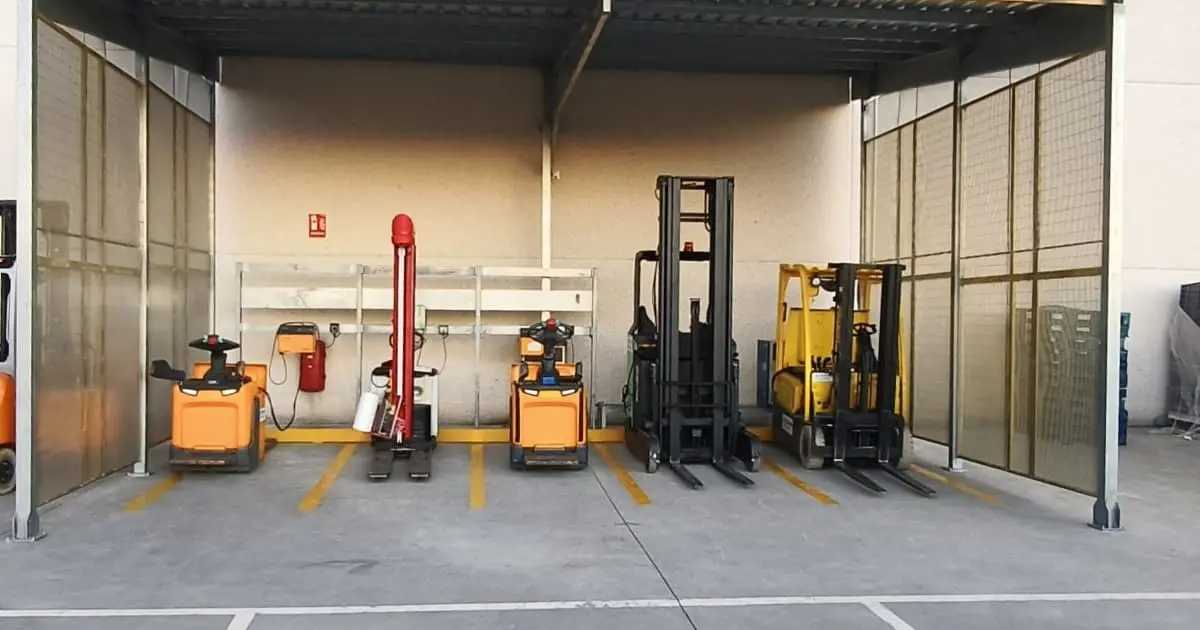
At Grupo TICE we are proposing a turnkey installation next to the industrial building: an outdoor battery charging room with natural ventilation, where Papa John's could charge its fleet of electric equipment without taking up any interior space.
The project included:
Design of the loading bay
We studied the most suitable location outside the ship and defined the layout so that the machines could enter, load and leave with ease
Natural ventilation
The room was designed to work with natural ventilation: a covered structure, open at the front and with mesh side panels that allow the continuous renewal of the air. Thus, the gases that are released during loading are not confined, as would happen in a closed corner of the interior of the ship, and the ventilation of the battery room It does not depend on mechanical equipment.
Electrical installation
We carry out the electrical installation necessary to power the fleet's chargers at their new location. [DATE TO COMPLETE: details of the electrical installation, if you would like to provide them]
Signposted loading areas
Each machine has its designated space marked on the pavement. This ensures that parking is organized, prevents collisions between equipment, and any operator knows where to leave each forklift or pallet truck.
Documentation
We provided the necessary documentation for the installation, so that the client could certify the work performed to their PRL service.
Results: compliance with PRL and more space in the ship
With the new room, Papa John's achieved two direct results:
- PRL requirement met. The lead battery load is now being carried out outside the ship, in a space with natural ventilation, as had been indicated by its prevention service.
- Space recovered. The interior area that used to be dedicated to cargo has been freed up for warehouse operations.
«Doing it with TICE is a guarantee.»
Gonzalo Paulos, Technical Purchasing Manager, Papa John's
Is your company in the same situation?
If you recognize yourself in any of these points, it might be a good idea to review how and where you charge your fleet:
- Loads of forklifts, pallet trucks or stackers with lead batteries inside the ship.
- Your PRL service, an audit or an inspection, has requested changes to the loading area.
- The current loading area takes up space for storage or for moving goods.
- Your fleet of electric machines has grown and the charging points have become insufficient or disorganized.
- You are not sure if the ventilation in your current charging area is sufficient.
Has PRL asked you to remove the battery pack from the ship?
Tell us about your case and we will help you find the battery loading bay that best suits your ship.
- Design and installation on-site
- Electrical installation and signposted parking spaces
- Documentation included
- Projects throughout Spain