
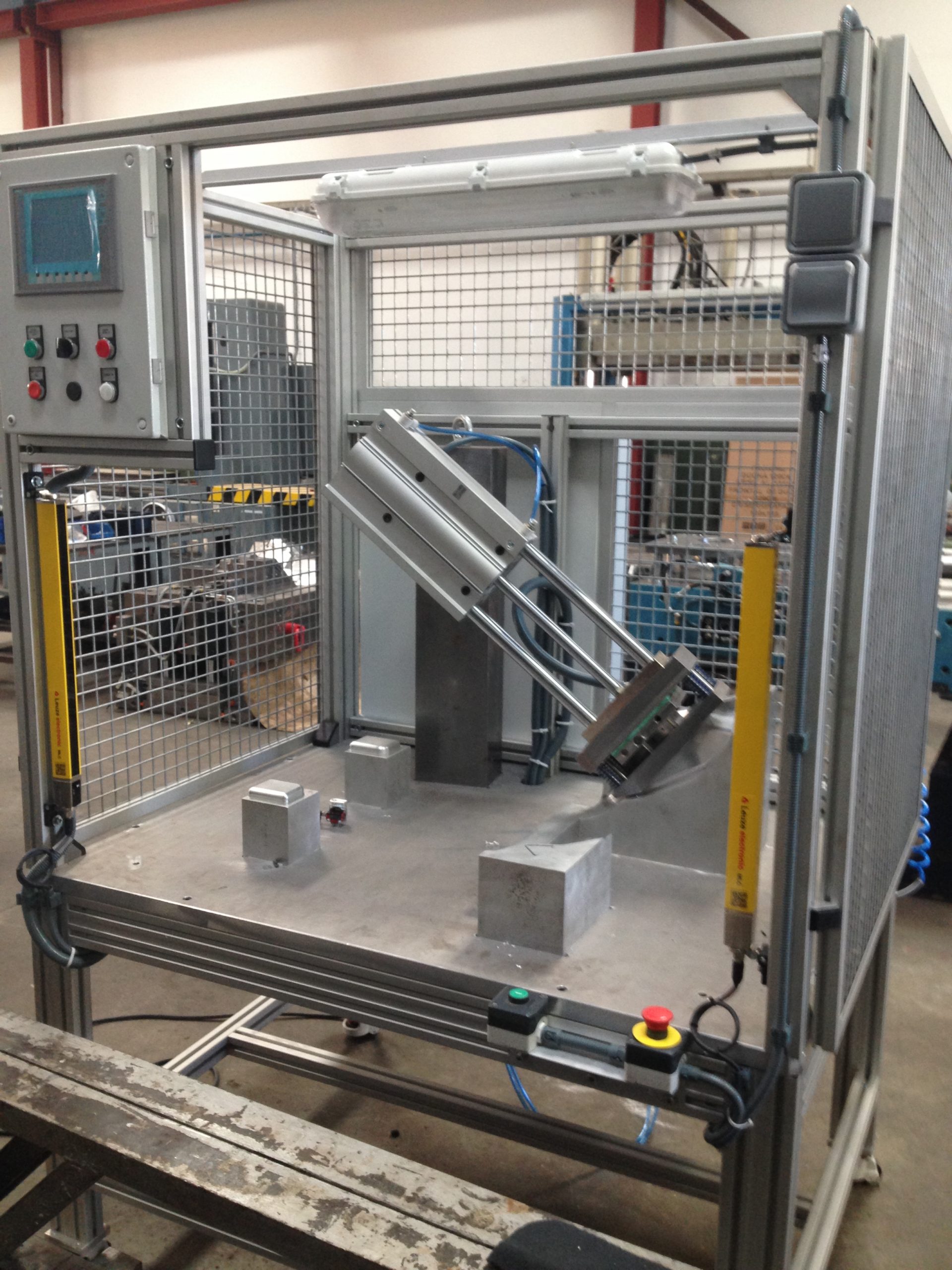
Nowadays, there is a great deal of misunderstanding within industrial safety regarding the suitability of machinery for Royal Decree 1215/97 and CE Marking. Many do not know the real difference between the suitability of machinery for RD 1215/97 and CE Marking.
Industrial safety aims to ensure that installations, machinery, and, in general, work equipment, provided by a company for its workers' use, are safe and reliable for the functions and activities they will perform. All actions related to industrial safety are carried out in the area of occupational risk prevention.
As we said at the beginning, every day we encounter many queries generated by the confusion between these two concepts, and in this article, we will look at the difference between the compliance of machinery with RD1215/97 and CE marking.
What is conformity and what is CE marking?
The conformity with Royal Decree 1215/97 It is a process of improving a work team or machine through which a certain level of safety is determined, required by Royal Decree 1215/1997.
However, The CE Marking (European Conformity Marking) It concerns a procedure whereby a manufacturer or importer declares that a specific product is to be placed on the market within the European Union, in compliance with a series of rules and requirements stipulated in the relevant mandatory legislation.
What are the differences between obtaining CE Marking and compliance with Royal Decree 1215/97?
What are the differences regarding the corresponding legislation for each certification?
The process for obtaining both certifications is, practically, the same:
- Identification of potential non-conformities.
- Assessment of the risk that each non-conformity may pose and the severity of the consequences it may entail. In this phase, the Initial Risk Assessment Report is obtained, which includes a set of regulations, directives, and harmonised standards to follow to resolve the problem that has occurred.
- Deficiency management. This section outlines proposals for eliminating identified risks or reducing them to the maximum extent possible if they cannot be eliminated. Subsequently, the design of measures adapted to reduce the risks is carried out.
- Application of the solution, that is, the implementation of measures and security monitoring.
- Obtaining the certificate.
Industrial safety legislation establishes specific procedures for the assessment and control of certain facilities. Some occupational safety and health legislation establishes an assessment procedure or regulates the conditions that premises, work equipment, assessment procedures, etc., must meet. When specific legislation for risk assessment does not exist but recognised standards are established, it is advisable to take them into account.
The only difference in the process of these certifications will be the criteria and the needs that will be evaluated. Suitability does not require the same requirements as CE Marking.
The CE Marking for machinery is obtained when the owning company intends to market it. If this is the case, the certification process would be based on the Royal Decree 1644/2008. Otherwise, if the company does not wish to market its machinery but intends to use it, it must, at a minimum, ensure that it complies with the required suitability requirements. In this situation, the certification process would be carried out based on Royal Decree 1215/1997.
If I have CE Marking, do I implicitly have conformity with RD 1215/97?
Yes. Both certifications are features of industrial safety, but CE Marking requires more than mere compliance; it is a step beyond. It is also true that CE Marking certification permits the marketing of the respective machinery, while compliance only allows its use by the company itself.
What documentation is necessary for obtaining CE Marking?
The documentation required for CE Marking is a Technical Construction File that includes the following elements:
- Instruction Manual.
- Master plans, wiring diagrams and pneumatic schematics.
- Parts list.
- Documents proving the simulation of any trial, if required.
- Risk assessment.
- Declaration of conformity.
This documentation shall be supplied by the company to the external organisation certifying the CE Marking. In the event that any substantial modification occurs during the certification process, this same organisation will be responsible for providing the company with said documentation, with its respective modification, together with the Declaration of Conformity for the CE Marking. If the company that owns the machinery does not possess said documentation, this must also be stated.
What information is included in the Declaration of Conformity for CE Marking?
The data included in the Declaration of Conformity for CE Marking are:
- Company name of the manufacturer, address and authorised representative.
- Name and address of the person within the organisation responsible for preparing the technical file.
- Description and identification of the machine.
- Specific indication that the machinery complies with the applicable provisions of this Directive and to the Official Journal of the European Union.
- Reference to harmonised standards which have been used.
- Place and date of the declaration.
- Identification and signature of the person authorised to draft this declaration on behalf of the manufacturer or their authorised representative.
Ultimately, if your company wishes to market a machine, it will need to have CE Marking for it, with a series of requirements. On the other hand, if you only intend to use it on your premises, you will only need to adapt it to RD1215/97.