Las máquinas industriales pueden generar peligros mecánicos, eléctricos, térmicos, ergonómicos o relacionados con el ruido, las vibraciones y las sustancias utilizadas. El nivel de riesgo dependerá de la probabilidad de que se produzca un daño y de la gravedad de sus consecuencias.
Identificar estos peligros y aplicar medidas de reducción adecuadas es fundamental para prevenir accidentes, cumplir con la normativa y garantizar que los equipos puedan utilizarse de forma segura durante todas las fases de su vida útil.
Los principales riesgos relacionados con las máquinas son los riesgos mecánicos, eléctricos, térmicos, acústicos, por vibraciones, radiaciones, sustancias peligrosas, deficiencias ergonómicas, incendios, explosiones y puestas en marcha inesperadas.
¿Cuál es la diferencia entre peligro y riesgo?
A peligro es una fuente con capacidad para causar una lesión o un daño a la salud. El riesgo combina la probabilidad de que ese daño llegue a producirse y la gravedad de sus posibles consecuencias.Por ejemplo, una cuchilla en movimiento constituye un peligro mecánico. El riesgo dependerá, entre otros factores, de la posibilidad de acceder a ella, de la frecuencia y duración de la exposición, de las medidas de protección existentes y de la gravedad de las lesiones que podría provocar.Principales tipos de riesgos en máquinas industriales
La identificación no debe limitarse al funcionamiento normal. También debe abarcar el transporte, montaje, ajuste, limpieza, mantenimiento, localización de averías, desbloqueo y retirada de servicio de la máquina.
| Tipo de riesgo | Ejemplos habituales | Posibles consecuencias | Medidas habituales |
|---|---|---|---|
| Mecánico | Atrapamiento, corte, aplastamiento, impacto o proyección | Heridas, fracturas o amputaciones | Diseño seguro, resguardos, distancias y enclavamientos |
| Eléctrico | Contacto directo o indirecto, arco eléctrico y sobrecarga | Quemaduras, electrocución o incendio | Aislamiento, puesta a tierra y protecciones eléctricas |
| Térmico | Superficies calientes, vapor, fluidos o frío extremo | Quemaduras o lesiones por frío | Aislamiento, resguardos y señalización |
| Ruido y vibraciones | Motores, prensas, impactos y herramientas rotativas | Hipoacusia, fatiga o lesiones musculoesqueléticas | Reducción en origen, encapsulado, aislamiento y mantenimiento |
| Radiaciones | Láser, ultravioleta, infrarroja o campos electromagnéticos | Daños oculares, cutáneos o internos | Cerramientos, pantallas y dispositivos de protección |
| Sustancias peligrosas | Polvo, gases, humos, vapores y fluidos | Intoxicación, irritación o enfermedad profesional | Contención, extracción localizada y ventilación |
| Ergonómico | Posturas forzadas, repetitividad, esfuerzo o mala visibilidad | Fatiga, errores y lesiones musculoesqueléticas | Rediseño del puesto, automatización y ayudas mecánicas |
| Incendio y explosión | Vapores inflamables, polvo combustible o fuentes de ignición | Quemaduras y daños personales o estructurales | Evaluación ATEX y control de fuentes de ignición |
| Energías acumuladas | Presión neumática o hidráulica, muelles, gravedad o inercia | Movimientos inesperados, golpes o atrapamientos | Consignación de energías, bloqueo y procedimientos LOTO |
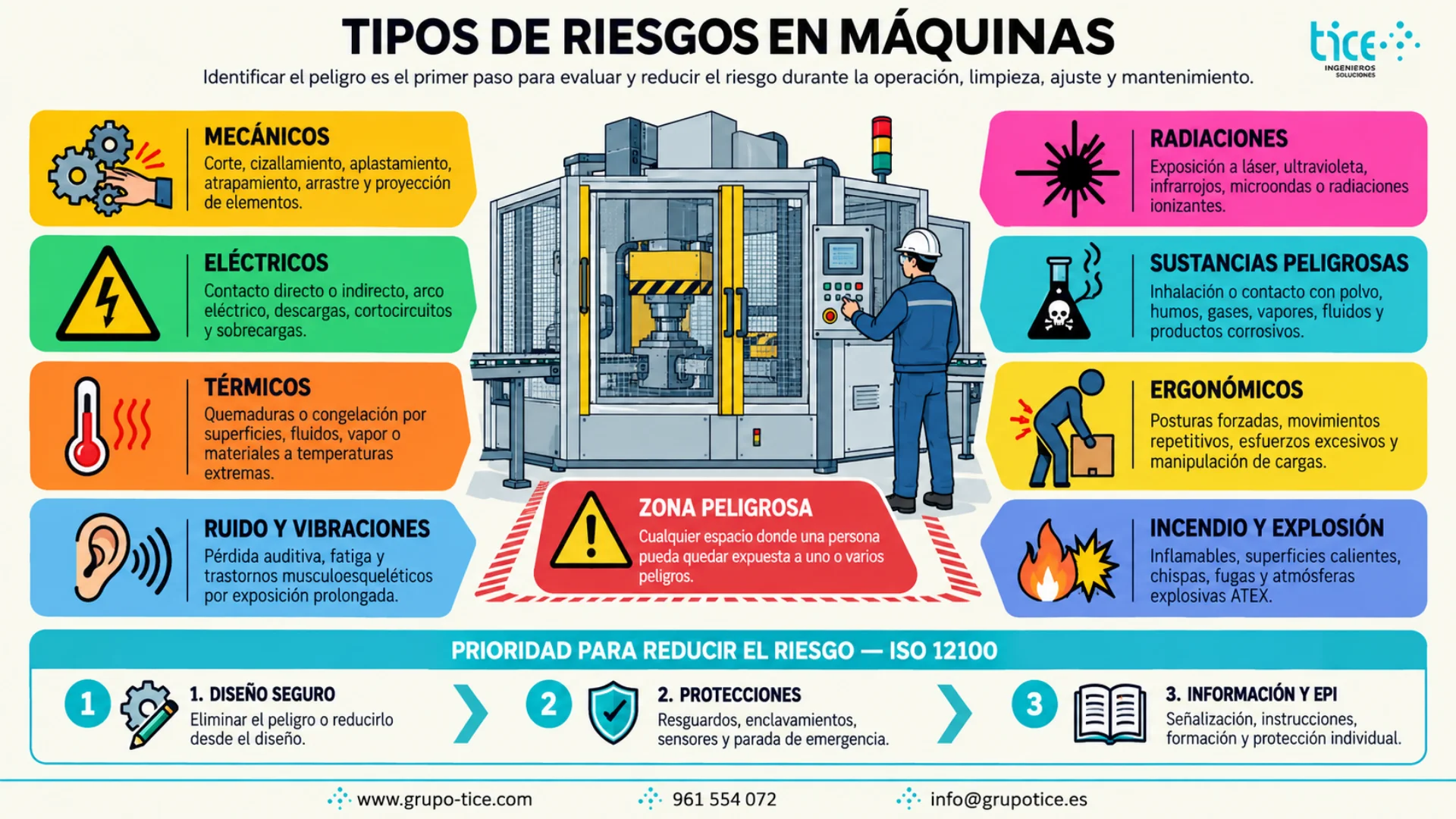
Riesgos mecánicos
Son los originados por elementos móviles, piezas, herramientas o materiales proyectados. Incluyen el aplastamiento, cizallamiento, corte, seccionamiento, enganche, arrastre, atrapamiento, impacto, punzonamiento, fricción, abrasión y proyección de fluidos a presión.
Riesgos eléctricos
Pueden producirse por contacto directo con partes activas, contacto indirecto debido a un fallo de aislamiento, electricidad estática, arcos eléctricos, cortocircuitos o sobrecargas. La instalación debe disponer de protecciones adecuadas y mantenerse en condiciones seguras.
Riesgos térmicos
El contacto con superficies calientes, vapor, materiales fundidos o fluidos puede provocar quemaduras. Las temperaturas extremadamente bajas también pueden producir lesiones. Deben valorarse tanto el contacto directo como la proximidad o la proyección de materiales.
Riesgos por ruido y vibraciones
El ruido puede causar pérdida auditiva, interferir en la comunicación y dificultar la percepción de alarmas. Las vibraciones pueden generar fatiga y trastornos musculoesqueléticos. La prioridad debe ser reducir ambos riesgos en su origen antes de recurrir únicamente a equipos de protección individual.
Riesgos por radiaciones
Determinadas máquinas pueden emitir radiaciones láser, ultravioletas, infrarrojas, ionizantes o campos electromagnéticos. La evaluación debe considerar la fuente, la intensidad, el tiempo de exposición y la posibilidad de acceso a la zona afectada.
Chemical hazards and exposure to hazardous substances
Los procesos industriales pueden liberar polvo, humos, gases, vapores, aerosoles o fluidos peligrosos. Las medidas preventivas pueden incluir cerramientos, extracción localizada, ventilación, detección, contención de derrames y procedimientos específicos de mantenimiento.
Riesgos ergonómicos
Una máquina mal adaptada al trabajador puede provocar posturas forzadas, movimientos repetitivos, sobreesfuerzos, fatiga física o mental y errores de operación. Deben revisarse la altura de trabajo, la accesibilidad, la visibilidad, los mandos y la manipulación de cargas.
Fire and explosion hazards
Los materiales inflamables, los vapores, los gases o el polvo combustible pueden formar atmósferas peligrosas. Cuando exista posibilidad de una atmósfera explosiva, será necesario analizar la clasificación de zonas, las fuentes de ignición y la adecuación de los equipos utilizados.
Puesta en marcha inesperada y energías acumuladas
Una máquina puede conservar energía eléctrica, neumática, hidráulica, mecánica, térmica o gravitatoria incluso después de detenerse. Para las intervenciones de limpieza o mantenimiento deben existir medios de seccionamiento, disipación, bloqueo y verificación de ausencia de energía.
What is meant by a machine's danger zone?
A zona peligrosa es cualquier espacio dentro o alrededor de una máquina en el que la presencia de una persona pueda suponer un riesgo para su seguridad o salud. Puede encontrarse en el punto de operación, en los sistemas de transmisión, alrededor de un robot o en áreas accesibles durante el mantenimiento.
El acceso puede limitarse mediante medidas como:
- Resguardos fijos o móviles.
- Dispositivos de enclavamiento y bloqueo.
- Barreras físicas y vallados perimetrales.
- Cortinas fotoeléctricas, escáneres o dispositivos sensibles.
- Mandos a dos manos cuando resulten adecuados.
- Distancias de seguridad frente al alcance de zonas peligrosas.
- Paradas de emergencia como medida complementaria.
La solución debe seleccionarse en función de la evaluación de riesgos. Una parada de emergencia, por sí sola, no sustituye a un resguardo ni elimina el peligro.
¿Cómo se realiza una evaluación de riesgos según ISO 12100?
La norma UNE-EN ISO 12100 establece una metodología general para identificar los peligros, estimar y valorar los riesgos y definir las medidas necesarias para reducirlos. El proceso debe considerar tanto el uso previsto como los usos incorrectos razonablemente previsibles.
- Determinar los límites de la máquina: uso previsto, usuarios, espacio, tiempo y condiciones ambientales.
- Identificar los peligros: analizar todas las tareas y fases de vida del equipo.
- Estimar el riesgo: valorar la gravedad del daño y la probabilidad de que se produzca.
- Evaluar el riesgo: decidir si se ha reducido suficientemente o si son necesarias nuevas medidas.
- Aplicar medidas de reducción: seguir el orden de prioridad establecido por la metodología.
- Documentar el resultado: registrar peligros, medidas adoptadas y riesgos residuales.
Orden de prioridad para reducir los riesgos
- Diseño inherentemente seguro: eliminar el peligro o reducir el riesgo desde el diseño.
- Resguardos y dispositivos de protección: impedir el acceso o detener las funciones peligrosas.
- Información para la utilización: advertencias, señalización, instrucciones, formación y, cuando proceda, equipos de protección individual.
Las advertencias y los equipos de protección individual no deben utilizarse como sustitutos de medidas técnicas que puedan integrarse razonablemente en la máquina.
Consulta nuestro servicio de evaluación de riesgos según ISO 12100.
Normativa aplicable a la seguridad de las máquinas
Para determinar las obligaciones aplicables debe diferenciarse entre la fabricación o comercialización de una máquina y su utilización como equipo de trabajo dentro de una empresa.
Royal Decree 1215/1997
Establece las disposiciones mínimas de seguridad y salud para la utilización de los equipos de trabajo por parte de los trabajadores. La empresa debe asegurarse de que los equipos puestos a disposición sean adecuados para el trabajo y puedan utilizarse sin comprometer la seguridad.
Real Decreto 1644/2008 y Directiva 2006/42/CE
Regulan la comercialización y puesta en servicio de las máquinas. El fabricante debe cumplir los requisitos esenciales de seguridad y salud aplicables, elaborar el expediente técnico, proporcionar las instrucciones, emitir la declaración CE de conformidad y colocar el marcado CE cuando corresponda.
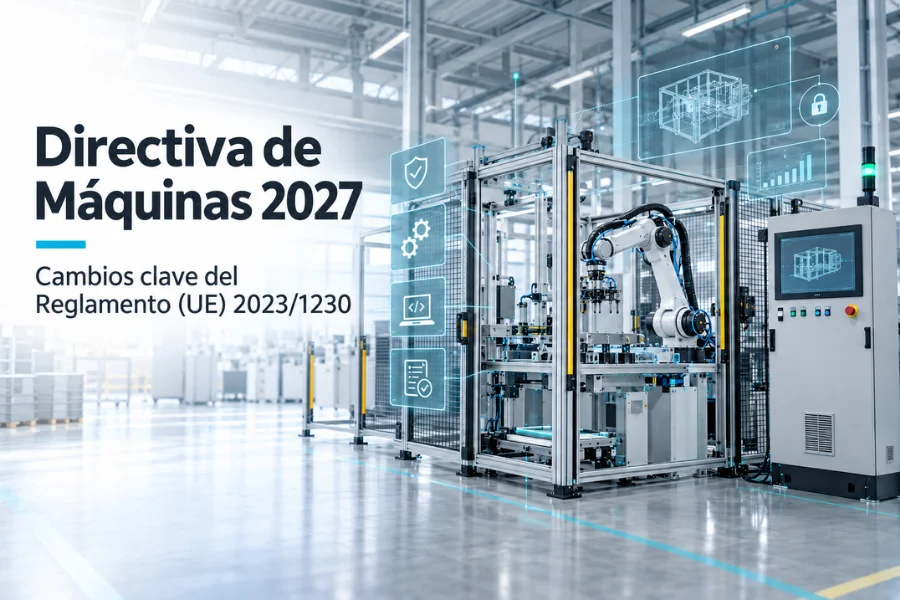
Reglamento (UE) 2023/1230
El nuevo Reglamento europeo de máquinas será aplicable con carácter general a partir del 20 de enero de 2027 y sustituirá a la Directiva 2006/42/CE. Introduce y refuerza aspectos relacionados con las tecnologías digitales, el software, la inteligencia artificial y la ciberseguridad vinculada a las funciones de seguridad.
Conoce los cambios principales del Reglamento (UE) 2023/1230.
¿Quién debe evaluar los riesgos de una máquina?
Responsabilidad del fabricante
El fabricante debe evaluar los riesgos derivados del diseño y la construcción de la máquina, aplicar las medidas necesarias y justificar el cumplimiento de los requisitos legales correspondientes antes de su comercialización o puesta en servicio.
Responsabilidad de la empresa usuaria
La empresa que utiliza la máquina debe verificar que el equipo sea adecuado para el trabajo, que se mantenga en condiciones seguras y que las personas trabajadoras dispongan de información, formación y procedimientos adecuados.
Máquinas modificadas
Cuando se modifica una máquina deben evaluarse los nuevos peligros introducidos y comprobarse si las medidas existentes siguen siendo válidas. Si la intervención altera de manera sustancial su funcionamiento, prestaciones o nivel de seguridad, será necesario estudiar también las obligaciones que pueda asumir quien realiza la modificación.
¿Cuándo necesita adecuación una máquina?
Una máquina puede necesitar una evaluación y un proyecto de adecuación cuando presenta deficiencias como las siguientes:
- Elementos móviles accesibles o resguardos inexistentes.
- Resguardos que pueden retirarse o anularse con facilidad.
- Distancias de seguridad insuficientes.
- Paradas de emergencia inexistentes, inaccesibles o ineficaces.
- Rearme o puesta en marcha inesperada después de una parada.
- Cuadros e instalaciones eléctricas con protección insuficiente.
- Falta de medios para consignar las fuentes de energía.
- Riesgos durante la limpieza, el ajuste o el mantenimiento.
- Modificaciones realizadas sin evaluación ni documentación.
- Ausencia de manual, planos, esquemas o documentación de seguridad.
La solución no consiste únicamente en instalar protecciones. Es necesario comprobar que estas sean compatibles con el proceso, que no generen nuevos peligros y que mantengan la seguridad tanto en producción como durante las intervenciones.
Más información sobre la adecuación de máquinas al RD 1215/1997.
Ejemplo: evaluación de riesgos de una prensa industrial
En una prensa pueden coexistir peligros de aplastamiento en la zona de trabajo, atrapamiento en elementos de transmisión, proyección de piezas, ruido, riesgos eléctricos y movimientos inesperados durante el mantenimiento.
La evaluación debe analizar cada modo de funcionamiento y cada intervención prevista. Dependiendo del proceso, las medidas pueden incluir resguardos fijos, dispositivos de enclavamiento, protección optoelectrónica, mando a dos manos, control seguro, parada de emergencia y medios de consignación de energías.
La selección final no puede realizarse únicamente por el tipo de máquina: debe considerar el proceso, el acceso necesario, los tiempos de parada, las características del sistema de mando y el nivel de riesgo identificado.
¿No sabes si una máquina cumple con los requisitos de seguridad?
At Grupo TICE Ingenieros realizamos evaluaciones de riesgos, inspecciones de maquinaria y proyectos de adecuación al Real Decreto 1215/1997. Analizamos el equipo, identificamos las deficiencias y definimos las medidas técnicas necesarias para reducir los riesgos.
Contamos con 20 años de experiencia desarrollando soluciones de ingeniería y seguridad industrial para empresas de ámbito nacional e internacional.
Fuentes y normativa de referencia
- Real Decreto 1215/1997, sobre utilización de equipos de trabajo.
- Real Decreto 1644/2008, sobre comercialización y puesta en servicio de máquinas.
- Reglamento (UE) 2023/1230 relativo a las máquinas.
- UNE-EN ISO 12100. Seguridad de las máquinas. Principios generales para el diseño. Evaluación y reducción del riesgo.
Preguntas Frecuentes sobre los Riesgos de las Máquinas
A hazard zone is any area where a worker may be exposed to hazards during operation, maintenance, or cleaning. These zones must be protected by:
- Reservations.
- Physical barriers.
- Emergency stop buttons.
- Sensors and locking systems.
Los más habituales son los mecánicos, eléctricos, térmicos, acústicos, por vibraciones, radiaciones, sustancias peligrosas, deficiencias ergonómicas, incendio, explosión y energías acumuladas. En una misma máquina pueden presentarse varios de forma simultánea.
Sí. El marcado CE acredita la declaración del fabricante respecto al cumplimiento de la normativa aplicable, pero la empresa usuaria debe evaluar las condiciones reales de utilización, el entorno, las tareas y la interacción con otros equipos.
Se aplica a los equipos de trabajo utilizados por las personas trabajadoras. Obliga a la empresa a garantizar que sean adecuados, se mantengan correctamente y puedan utilizarse de forma segura.
Deben considerarse el transporte, montaje, puesta en marcha, producción, ajuste, limpieza, desbloqueo, mantenimiento, reparación y retirada de servicio, así como los usos incorrectos razonablemente previsibles.
No. La parada de emergencia es una medida complementaria. No sustituye a las medidas de diseño seguro, a los resguardos ni a los dispositivos de protección necesarios para impedir o controlar el acceso al peligro.
<p>Debe revisarse la evaluación de riesgos, documentar los cambios y comprobar que las funciones de seguridad continúan siendo eficaces. Según el alcance de la modificación, pueden surgir obligaciones adicionales para la empresa que la realiza.</p>