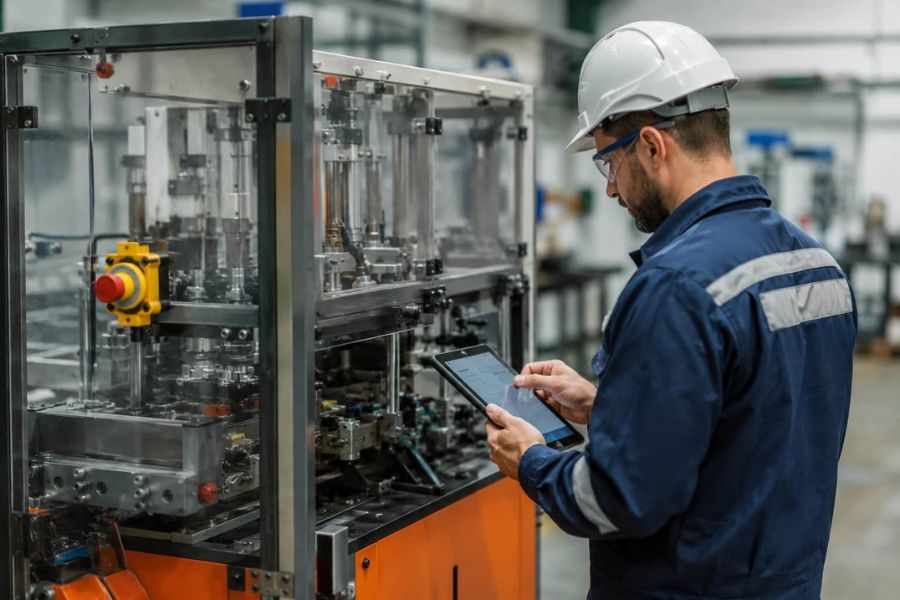
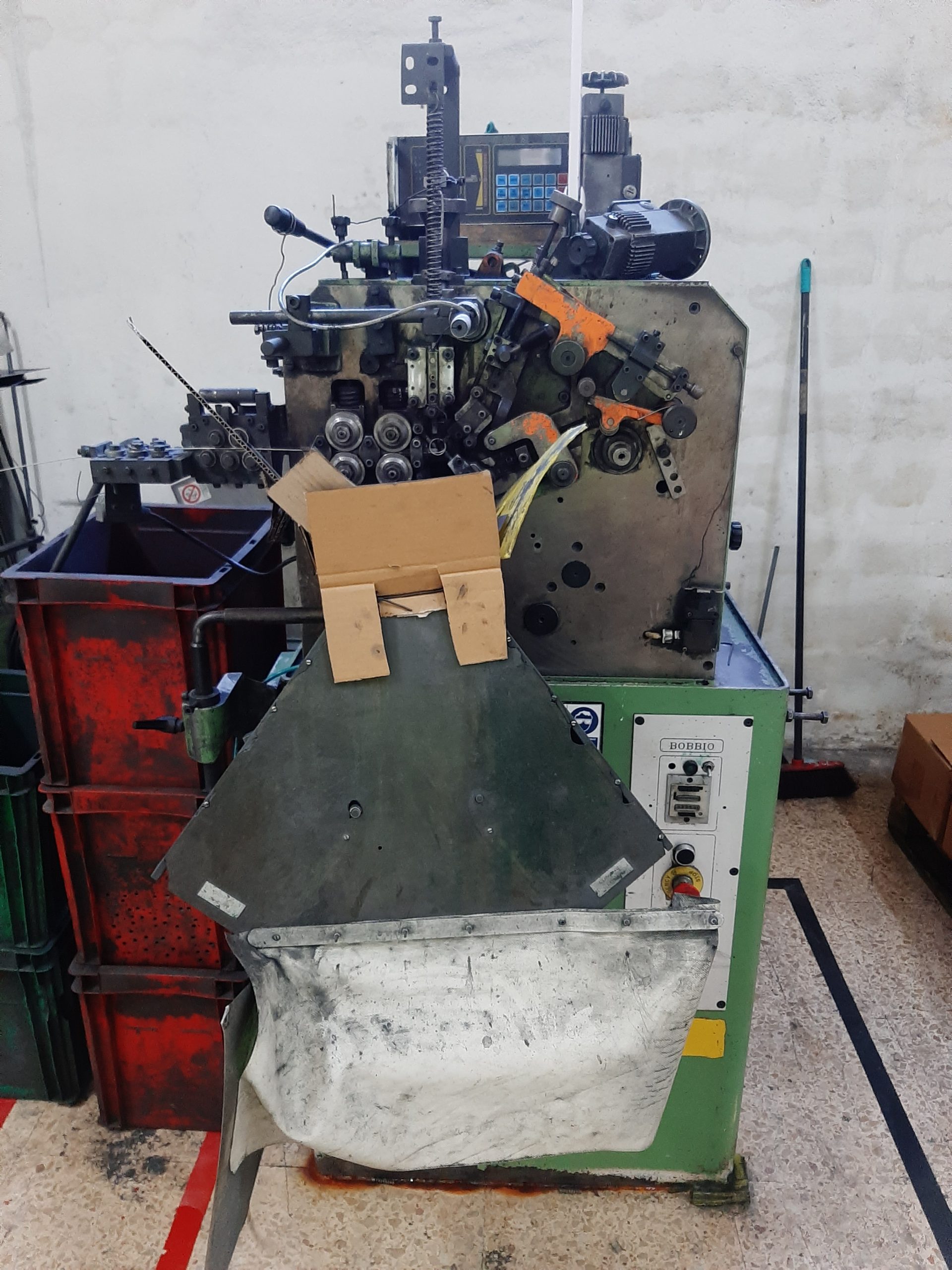
First, an inspection of the machine was carried out, which led to the Initial Risk Assessment Report. This report details the aspects that comply and do not comply, in accordance with the aforementioned regulations.
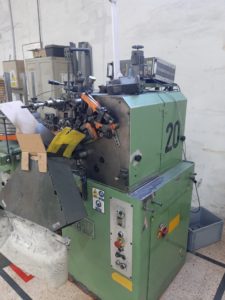
Regarding the non-conformities that arise in this project, we found:
- Actuator organs. It is not clear what each button is for, there is no adequate signage for them and furthermore the buttons are located below the service levels.
- Falls from projections and objects. The team is at risk of falling objects or projections and has no adequate protection for these risks.
- Burst or rupture. The equipment is at risk of breaking or bursting and there is no protection for the workers.
- Protection against moving parts. There are no guards against moving parts of the work equipment that prevent access to the danger zone or that stop dangerous operations before accessing these zones.
- Alarm devices. There is no alarm device.
- Signage. The essential warnings and signage to guarantee worker safety are missing.
- Electricity. The work equipment is not suitable for protecting workers exposed to the risk of direct or indirect contact with electricity. The electrical parts do not comply with the relevant specific regulations. Documentation for all existing electrical schematics has not been provided.
Once the initial risk assessment has been carried out, with its corresponding report, development of the measures applied to reduce or eliminate risks proceeds, so that these non-conformities comply with the regulations of Royal Decree 1215/97.
The dangers identified in this machine due to the list of non-conformities amount to 12. Below, we detail each danger, identifying its type, the level of risk, and the solution that is applied in each case.
- Signalling for operating organisations. This is a mechanical hazard that poses a significant risk. Only the emergency stop button is clearly marked; there are no labels indicating how to operate the machine. To mitigate this risk, we have clearly labelled each of the machine’s start and stop controls to ensure they are used correctly and safely, thereby reducing the risk to a low level.
- Machine status signalling. This is a mechanical hazard that presents a significant risk. There are no alarm devices on the machine, so its operating status is unknown, nor is it possible to know if it is switched off or on. To reduce this risk, we have installed a signalling beacon to indicate when the machine has power, when it is running, etc. Furthermore, it will also signal any incidents. This way, the risk is reduced to a low level.
- Machine control positioning. This is a mechanical hazard with a negligible risk. The control mechanisms are located below 0.6m in the front area. To reduce this risk, we relocated the machine's actuating mechanisms to the appropriate height and in a safe position for the operator, outside the machine's operating area. Even with this risk reduced, it remains a negligible risk.
- Electrical technical documentation. This is an electrical hazard that poses a significant risk. The electrical panel is unidentified and there is no electrical diagram. To reduce this risk, we organised the electrical panel, identifying all the elements and creating the electrical diagrams, thereby reducing the risk to a low level.
- Verification of stops. This constitutes an electrical hazard that carries a significant risk. Due to the absence of electrical diagrams, the positive action function of the emergency stops cannot be verified. To mitigate this risk, we will verify this fault after creating the aforementioned relevant electrical schematics, thereby reducing the risk to a low level.
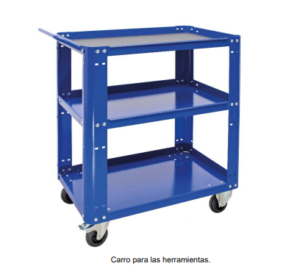
- Falling objects. This is a mechanical hazard that carries a significant risk. There are numerous tools and items above the machine that could fall onto the operator or the mechanisms. To reduce this risk, we remove unnecessary items for the machine's operation and secure those that are required. These tools should be placed in an external tray or on a cart, outside the machine's working area. In this way, the hazard is reduced to a negligible risk.
- Guards against the mechanism. This constitutes a mechanical hazard that presents a significant risk. There is no guarding on the front of the machine, leaving the mechanism exposed to the potential approach of moving parts. To reduce this risk, we have fitted a protective screen over the machine's mechanism, complete with the relevant safety sensors, preventing access to it without minimum safety conditions. This way, the hazard is reduced to a negligible risk.
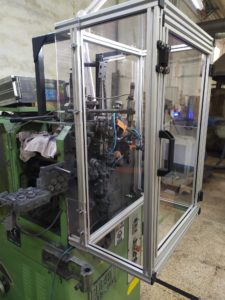
- Guards against the mechanism. This is a mechanical hazard that carries a significant risk. The safety device to prevent the machine starting without its front cover fitted is bypassed. To reduce this risk, we are using the same solution as mentioned in the previous section and, as in the previous case, the risk becomes negligible.
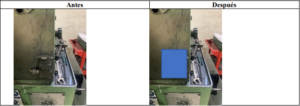
- Ejection of parts. This is a mechanical hazard that carries a negligible risk. The exit of parts is not protected, so damage may occur in the event of uncontrolled ejection. To reduce this risk, we have adapted the collection container for parts from the front protective guard, facing the part mechanism, so that it functions with the relevant safety features. Even with this reduction, it remains a negligible risk.
- Electrical contact. This is an electrical hazard that carries a significant risk. The flexible conduit covering the power cables is damaged, leaving the electrical wires exposed. To reduce this risk, we replaced the damaged insulating conduit with a new one, thus making it a negligible risk.
- Motor exposed. This is a mechanical hazard that poses a significant risk. The electric motor is exposed, which presents a danger of entrapment and component breakage. To reduce this risk, the housing parts corresponding to this area are fitted in such a way that they can only be removed with a tool. If frequent opening of this part is required, safeguards against opening must be installed. This way, the hazard is reduced to a negligible risk.
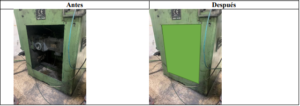
- Electrical contact. This presents a noise hazard that carries a significant risk. There is high noise due to the machine's casing being partially removed. To reduce this risk, we use the same measures as in the previous section, additionally stipulating that personnel must be provided with the necessary PPE. This way, the hazard is reduced to a negligible risk.