Meet the TICE group in Industrial Safety, another success story
Today we're explaining our new success story in the area of Industrial Safety. One of our clients, who specialises in the surface coating of parts, contacted us to adapt part of their machinery. They have machinery that is over two decades old and still operates mechanically in an excellent manner. However, concerns arose regarding whether they complied with current safety regulations, leading them to collaborate with Grupo Tice.
Firstly, the risk and conformity assessment report was carried out in accordance with the RD 1215/97, and our own risk assessment system to identify, evaluate and manage risks based on ISO 12100.
The features of the machines our client was using comprised a conveyor belt that applied a screw coating, an oven for curing the coating, and a rejection system for parts. Their manufacture dated back to the mid-90s and they were built with robust mechanics. The technological and automation level was medium, as a modernisation had already been carried out, introducing a rejection system using cameras, detectors, and a control logic system via a PLC.
Your specific specifications and requirements were as follows:
- Meet the minimum safety requirements of RD 1215/97, as indicated in Annexes I and II
- Conserve the machinery.
- Incorporate modifications without updating the control system.
- Maintenance team intervention is required to adapt each model for production.
- Minimally modify the method of operation.
- Internal actions were previously carried out without achieving positive results.
- The guards should be simple to remove.
During our assessment, we identified several hazards that needed to be rectified:
- Jamming with the reject mechanism: This reject mechanism acts as a pneumatically operated flap. When it receives a signal for a faulty component, it opens to reject it. When components are good, it closes, sealing the gap and causing a risk of jamming.
- The emergency stop device does not stop the entire equipment.
- Low machine safety level, absence of safety modules.
- There is no electrical isolating switch to disconnect it from the electrical supply.
After evaluating the machinery and identifying its hazards, we managed to develop a solution to your problem. We'll tell you the steps that Tice Group develop to offer them the perfect solution for our client.
- Step 1: Define the limits of regulatory machines, applicable ones, and equipment description.
- Step 2: Data collection in the field, identifying hazards and operational defects.
- Step 3: Discussion with the engineering team and seeking solutions according to needs and specifications.
- Step 4: Risk Assessment Report Generation.
- Step 5: Detailed engineering design, working closely with the client to adapt proposals, causing minimal disruption to their current operations. This step was crucial as it involved reaching agreements with maintenance, production, and company management, which led us to design and reconfigure mechanical protection elements.
- Step 6: Implementation of corrective actions and document renewal.
- Step 7: Delivery of certificate endorsed by an official entity.
On the other hand, the design of the protections went through different proposals:
- Proposed Solution 1: It was proposed to cover the rejection mechanism with transparent polycarbonate panels, bolted to the existing equipment. This way, it's ensured that the screws follow their path and there's insufficient distance to reach the danger zone with a hand. Solution rejected, as quick access to the rejection mechanism is needed in case of a jam.
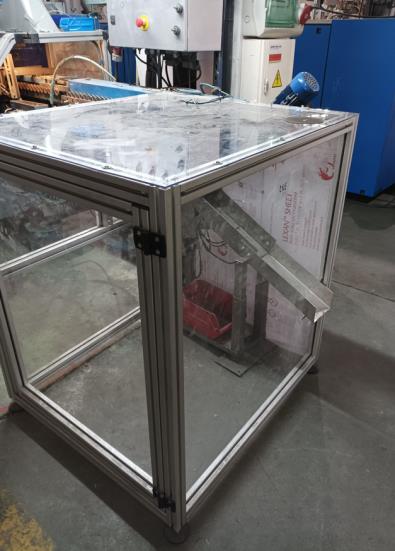
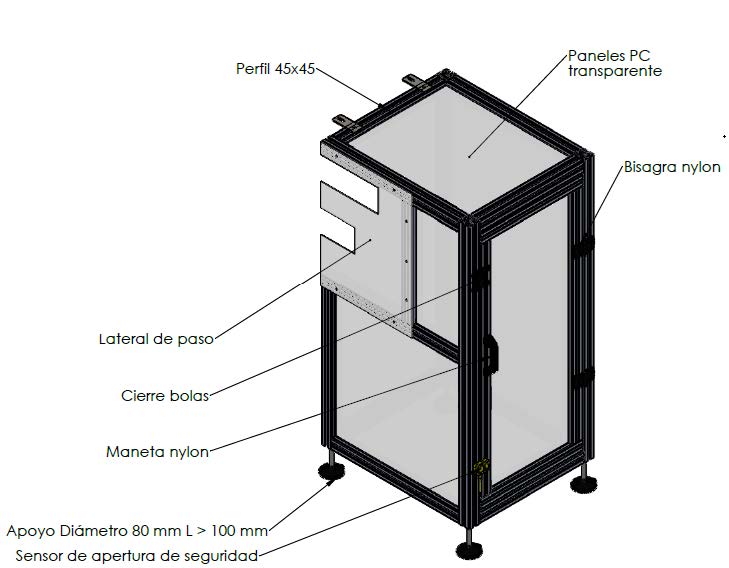
- Proposed solution 2: Cover made from aluminium profiles and transparent polycarbonate panels, with a front door and a safety opening detector, adjusted to take up the minimum possible space. Solution accepted with modifications. They need to have access to the boxes where they deposit the final product, and the cover should be of a larger size to house an extra motor for the machine and the entire camera system for rejection inside (previously they were located elsewhere).
- Revised Solution Proposal 2: The hood is sized according to your instructions and a variation is made to the rejection ramp. This ramp is extended and will deposit the valid parts outside the hood, so that the hood will only be opened if there are jams or problems with the rejection. If the door is opened, the detector will be activated and the rejection mechanism will stop working.
A recent achievement that Tice Group It takes pride in itself, as it enables our client to perceive that their organisation is considerably safer for their workforce.