
Every employer has a responsibility to take the necessary measures to ensure that the machinery made available to employees is in perfect working order. This does not simply mean that it is in good condition, but that it meets the minimum safety requirements applicable to it according to its year of manufacture, taking into account the RD 1215/1997.
To ensure this task is carried out effectively, it is recommended that businesses seek advice from firms specialising in technical and legal expertise and industrial safety, such as Grupo Tice.
Laws evolve over time, so the regulations that apply will depend on the year the machine in question was manufactured and placed on the market. Below, we’ll outline the minimum safety requirements for machinery and work equipment manufactured before 1995. Let’s get started!
Safety of machinery and work equipment manufactured before 1995
If the machinery and work equipment were manufactured and placed on the market before 1 January 1995, they are governed by the safety standards set out in Royal Decree 1215/1997, meaning that their minimum safety requirements are as follows:
- To have a control device that brings the machinery to a complete stop and ensures the safety of the operator and those in the vicinity.
- To protect operators in the event of fire, machine overheating, or the release of gases, dust, liquids or other hazardous substances produced or emitted by the machine or work tool. To provide clearly identifiable devices that make it easy to identify each of its energy sources.
- Put in place safety measures to prevent the risk of harm arising from the equipment or from substances stored, produced or emitted by it.
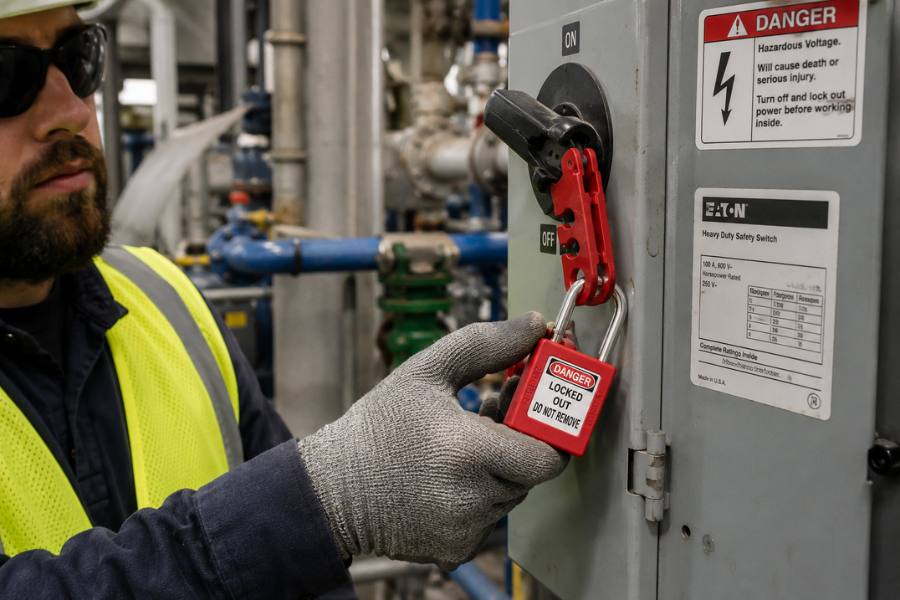
- Clear and easy-to-understand signage must be in place to warn workers and protect them from direct or indirect contact with sources of electricity.
Safety for workers operating the machinery
Furthermore, among the minimum safety requirements for machinery and work equipment manufactured before 1995, as set out in Royal Decree 1215/1997, it is stipulated that the employer must provide protective equipment to the operator or worker in the event that:
- There is a risk of falling objects and flying debris.
- The worker is at risk of developing physical problems due to high levels of noise, radiation or vibration.
- When operating the machinery, there is a risk that parts may burst or break.
- There is a risk from the release of gases, liquids, vapours or dust.
- The machinery or equipment is used to transfer, move or process corrosive liquids at high temperatures.
Safety in the areas where the machinery will be used
Finally, the minimum safety requirements for machinery and work equipment manufactured before 1995, in terms of the area in which they will be used, are as follows:
- Work equipment or machinery must be fitted with an alarm system that is easily audible and understandable.
- Work areas must be well lit when operating machinery.
Tice Group, experts in industrial safety
If you need advice regarding the minimum safety requirements for machinery and work equipment manufactured before 1995, please do not hesitate to contact us. We have a team of experts in industrial safety who will answer all your questions and provide a service tailored to your needs.