Discover TICE in Industrial Safety, new success story: Adaptation of an industrial furnace to RD 1215/97
Today we're telling you about our latest success story in the field of Industrial Safety. One of our clients in the agri-food industry contacted us to adapt some of their machinery. This machinery continues to operate mechanically in an optimal way, but they needed our help for the Suitability of machinery to RD 1215/97 and meet current safety requirements, and they decided to place their bet on Grupo Tice.
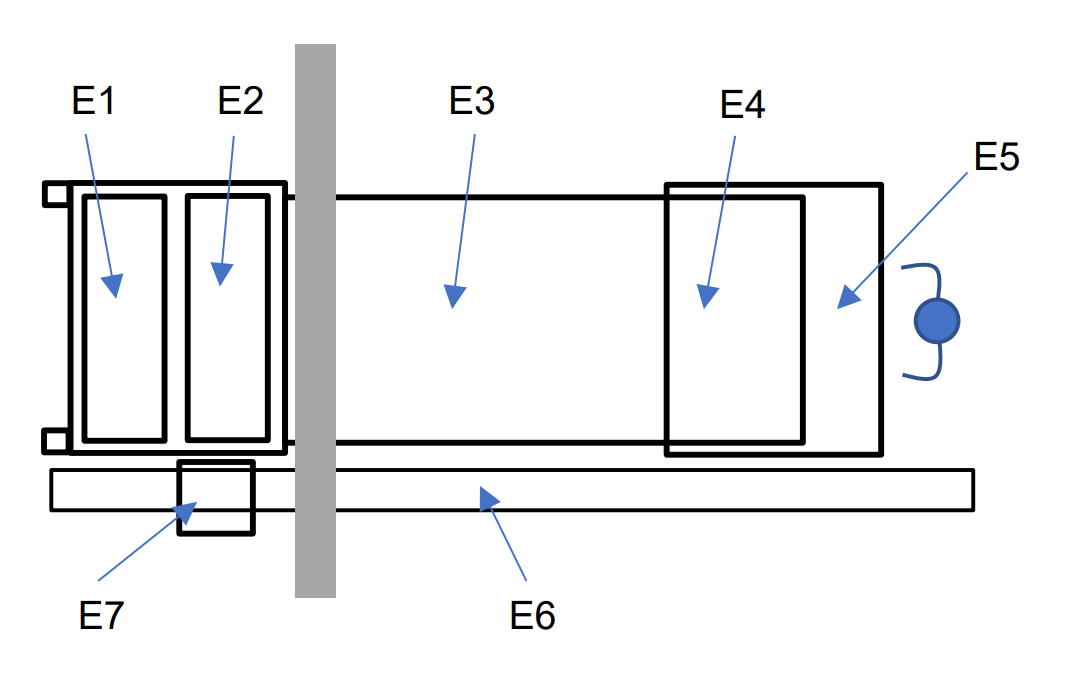
The team we had to evaluate is made up of a set of machines, differentiating between the robot (E1), the dosing machine (E2), the oven (E3), the main conveyor belt (E4), the cake collection area (E5), the auxiliary feed conveyor belt (E6), and a tray greaser (E7).
Its operation consists of the positioning of the trays by the robot. E1 About the conveyor belt E4 and the dosing team E2 Deposit the tart dough onto each of the trays. Periodically, an operator must manually extract a sample of the injected dough, with the aid of an extender. After this, the trays enter the oven. E3 for its cooking and on leaving E5 An operator, with the aid of gloves, removes the trays and organises them onto a trolley.
Finally, these trays are returned to the auxiliary belt E6 which is responsible for powering the robot E1 once again to start the cycle, having previously passed through the tray lubricator E7. Operator intervention is only necessary for tray removal at the final stage. E5 And for taking the mass sample in the dosage E2.
Initially, the machine consisted of the main oven and a burner. Later, the dispensing robot was introduced, which is fully automated. The empty trays must be manually loaded by the operator. The E6 conveyor belt automatically returns empty trays and takes them to the start of the machine to begin the process again. These, with the baked product, must be manually removed by the operator at the oven's exit.
Its specifications and requirements were as follows:
The specifications and requirements were of various kinds. Complying with the minimum safety measures of RD1215/97, as indicated in its Annexes I and II, maintaining the equipment, integrating changes without modernising the control system, adjusting the equipment by maintenance personnel on each model to be manufactured, modifying the work process as little as possible, and the protections had to be easily removable.
Dangers detected
The hazards detected during the inspection were several, and we can divide them into mechanical and electrical.
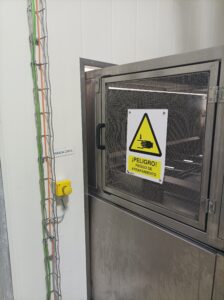
Mechanically, there is a lack of guarding on the sides at the chain outlet, a lack of guarding on the drive chain at the oven outlet, the side guards can be manually removed without tools, providing access to dangerous parts of the machine, inadequate guarding on the pneumatic actuator for tray separation, the safety barriers at the entry to the dosing robot do not comply with the distance established by standard EN ISO 13855, lack of entrapment risk signage, lack of high temperature risk signage, and lack of mandatory glove use signage.
From an electrical perspective, the emergency stop manoeuvre in the main oven control panel is at 220v and acts directly on the machine's general contactor. The issues include the lack of a disconnector in the main oven control panel, the lack of a disconnector in the auxiliary dosing robot control panel, the absence of emergency stops in dangerous parts of the machine, and emergency stops that are not identified and which do not stop the machine entirely.
After reviewing the entire package, our engineers proceed to develop the solution for the correct adaptation of the machine. We break down the steps for you. Tice Group Develop to offer our client the best solution.
A Mechanical level, Protections are designed and fitted to the sides at the chain's exit, protections to the drive chain at the furnace exit, and side guards are fixed. The cover is also designed and installed on the pneumatic tray-separating actuator, along with the installation of barriers to comply with the distance established by standard EN ISO 13855. Furthermore, we identify and signpost zones with entrapment risks, zones with high temperature risks, and zones where gloves are mandatory.
A Electrical level, We disconnected the emergency stop from the general contactor and installed a safety module with manual reset and emergency stops linked to it. All operations linked to the safety module will be carried out at 24VDC. We installed a disconnector in the main oven panel, a disconnector in the auxiliary dispensing robot panel, and emergency stops in dangerous parts of the machine. Lastly, to complete the adaptation, we installed emergency stop and controlled stop push buttons using colour codes.
A new success story of which Tice Group he is proud as it allows our client to feel that their company is much safer for their workers.