Robotics, market forecasts and industry incorporation In Spain
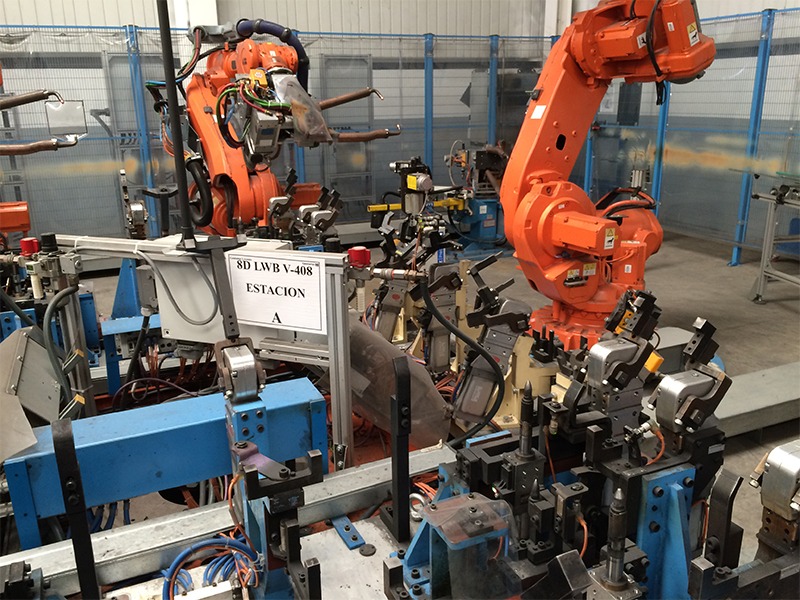
When we talk about automation, we are referring to the process by which a machine is capable of carrying out an activity without the need for human intervention.In this sense, talking about automation is talking about industrial robotics, where robots are used to carry out certain processes automatically in the industrial field.The automation of processes through the application of robotics has marked a before and after in industry, enabling its digitalisation at giant leaps and optimising manufacturing and final production processes.The rapid advancement of robotics is constantly changing the world. Currently, robots are already a key element in Industry 4.0 and the idea of working together between robots and humans is a reality, even in areas we could not have imagined years ago.Technology evolves and industry must always be constantly updated to apply those advances that allow for greater efficiency in the production process.
Spain: 4th European power in robotics
Although there is still a long way to go, Spanish companies are already standing out in the robotics sector internationally. According to the Spanish Association of Robotics and Automation, Spain ranks as the fourth European power in robotics and tenth worldwide, behind others such as China, Japan, the United States or South Korea, among others.
Industrial robotics was a growing sector before the pandemic, and now, after the crisis caused by Covid-19 which led to the paralysis of the global economy, it is predicted that the negative effects, rather than being felt in this sector, will lead to an increase in investment in industrial robots.So, how will COVID-19 affect robotics in Spain?
In this regard, the
International Federation of Robotics (IFR) which foresees that,
by 2022, investment in industrial robotics in Spain is expected to grow by an average of 101% per year.
The pandemic has proved to be a real accelerator of digitalisation. The industry faces a significant number of challenges as a consequence of this health situation: protecting workers' health, dealing with a drop in demand in some cases or a sudden increase in others; the need to be more productive and efficient, etc.Automation can be an ally in facing these consequences and a key element for forward-thinking companies that want to stay on that path.
Advantages of human-robot collaboration
Still a long way from replacing human workers, robotics has managed to improve productivity by performing monotonous or repetitive tasks, while allowing workers to focus on more complex tasks or those that do require human intervention.In this regard, workers are increasingly willing to accept the presence of collaborative robots in their work environment and have moved from seeing them as a technology that could replace them to viewing them as a tool capable of making their jobs easier.And indeed, for the moment, a robot is not capable of providing the dexterity or problem-solving ability of a person, but it is capable of offering precision, strength, and endurance that the human body cannot sustain in certain tasks.Furthermore, there are innumerable possibilities for robotic applications in industry, and their high degree of specialisation allows for the design of specific robots for almost any moment in the production chain.If we refer to the
Advantages of applying robotics in industry, we can highlight some as:
- Ease and speed when programming and configuring the robot
- Optimisation of production processes. Robots are capable of improving the uniformity of production processes and reducing raw material waste, one of the main objectives in industry.
- Very low margin of error. Robotics is reliable in operations where zero operator error is sought, making it suitable for high-demand production lines.
- Flexibility to scale capacity up or down According to demand.
- Consistent performance. They are ready to operate 24 hours a day, as well as to be easily reprogrammed depending on the task and as many times as necessary.
Technology has improved people's lives. It is undeniable that robotics is part of our present and, of course, our future. Robotic technology is here to stay, and accepting and developing it is an opportunity we must not miss.