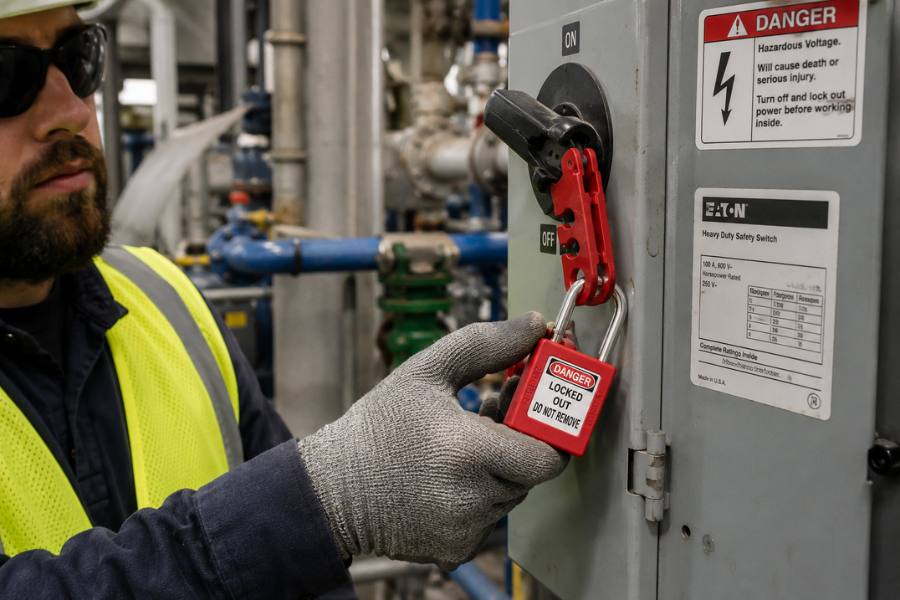
Safety in industrial machinery is a priority in modern industry.
The EN ISO 13849-1 standard has established itself as an essential reference for ensuring that safety-related control systems meet the necessary requirements to protect operators and maintain process integrity.
What is EN ISO 13849-1?
The EN ISO 13849-1 It is an international standard that sets out the requirements for the design and integration of safety-related control system parts (SRP/CS) in machinery.
Its main objective is to provide a framework for evaluating and ensuring the reliability of safety functions implemented in machine control systems.
This standard applies to all control technologies, whether electrical, electronics, Hydraulics, tyres o Mechanics, and focuses on ensuring safety functions are appropriately designed and validated to reduce risks associated with the use of machinery.
Niveles de Prestación (PL) y su importancia

Key Components for Determining PL
To calculate and verify the PL of a safety function, EN ISO 13849-1 considers several essential parameters:
- MTTFd (Mean Time to Dangerous Failure): Indicates the reliability of individual components and is classified as low, medium, or high.
- DC (Diagnostic Coverage): Reflects the system's ability to detect faults and is expressed as a percentage.
- CCF (Common Cause Failure): Assess the probability that simultaneous failures in different parts of the system have a common cause.
These parameters, along with the control system architecture (categories B, 1, 2, 3 and 4), allow the achieved PL to be determined and compared with the PLr established in the risk assessment.
Do you need technical advice?
At TICE we help you design and implement secure, optimised, and regulation-compliant control systems.
Significant Changes in the 2023 Version of the Standard
The latest version of EN ISO 13849-1, published in 2023, introduces several significant updates:
- Improved Structure Present a clearer structure, facilitating the implementation of security functions such as subsystem combinations.
- Focus on Subsystems: The term «subsystem» is adopted, reflecting a more modular view of security system design.
- Safety Requirements Specification (SRS): More detailed guidelines for the SRS elaboration are provided.
- Software Considerations: Specific requirements relating to software design and validation are incorporated.
- Integrated Validation: The requirements of ISO 13849-2 are integrated into this new version, facilitating a more coherent validation approach.
EN ISO 13849-1 Implementation Process
The effective implementation of the standard involves:
- Define the necessary security functions
- Determine the acceptable risk level (PLr) by risk assessment
- Design and implement the security function
- Calculate the achieved PL (MTTFd, DC, CCF)
- Verify and validate the implemented functions
This systematic approach ensures that security measures are effective and compliant with current regulations.
The EN ISO 13849-1 It is a fundamental tool for designing reliable and effective industrial safety systems. Ensuring regulatory compliance not only protects people but also improves efficiency, trust, and competitiveness for businesses.
At Group TICE, We are specialists in the adaptation of machinery and industrial safety systems. Our technicians analyse, design and execute projects compliant with regulations, guaranteeing results and conformity.