What are Control Gauges?
We all know that currently Every business seeks to have the best products at the lowest possible price, but always guaranteeing in the most efficient way possible that their products meet quality standards, which is why I want to make special mention of control gauges.
The control gauges They are control elements that allow us to understand the deviations in our manufacturing processes in a simple, quick, and very precise way.
Dimensional check gauges are used to improve control and quality processes by quickly and easily checking multiple references in a single tool. For this purpose, we have various types of gauges. What are these?
Types of control gauges.
There are four types of control gauges that we will look at next.
- First of all, we have Fixings What they serve to correctly position the part for subsequent measurement by CMM, coordinate measuring machine. Whether self-supporting or in aluminium sheets.
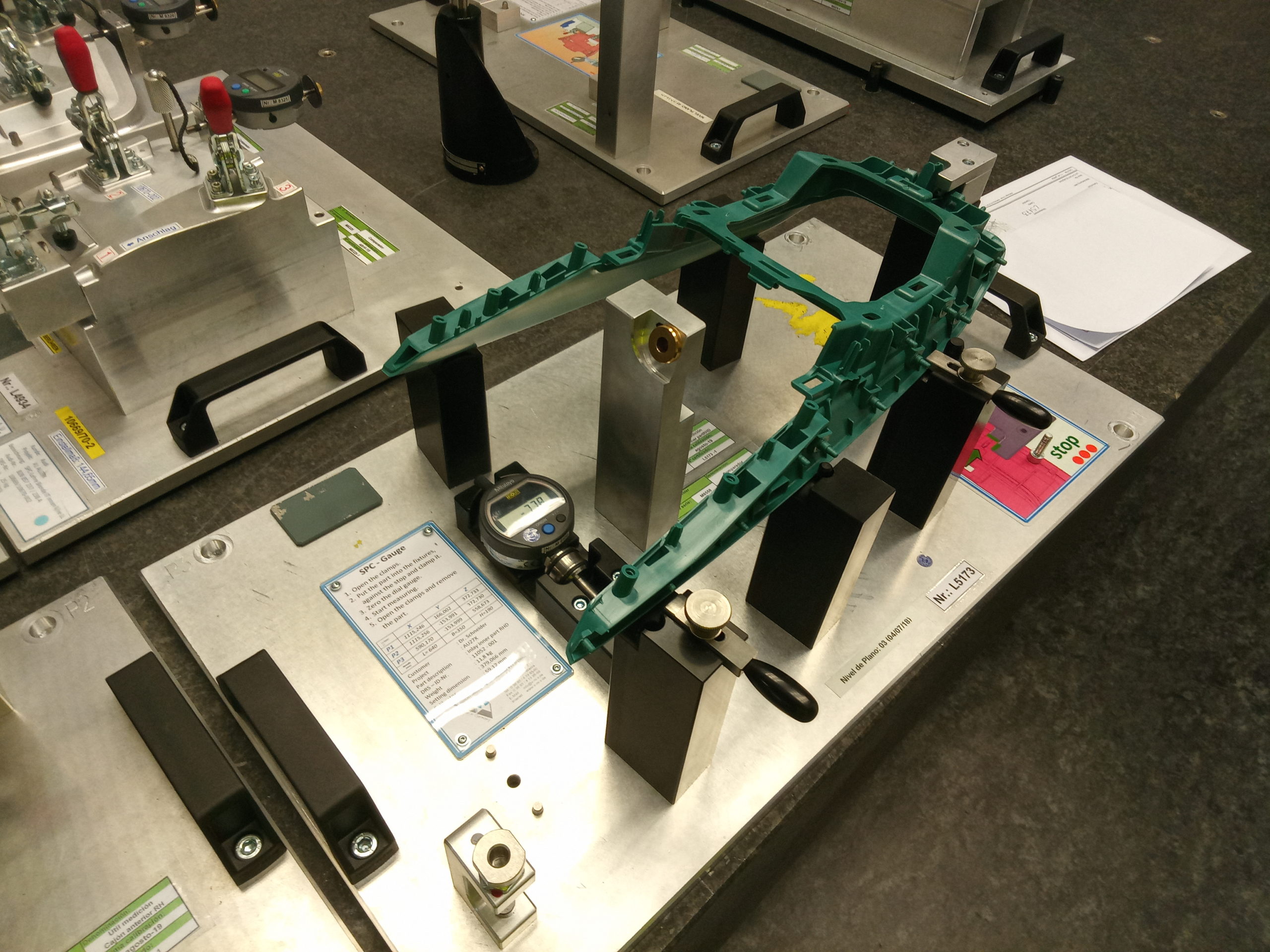
- On the other hand, we have The gauge blocks, which can be manufactured in aluminium or resin. This manufacturing process involves reproducing the negative of the part, controlling its clearance and levelling. Various measuring systems, such as dial gauges, can be installed in this gauge.
- Another type of Greyhound are the Meisterbock, what is a A large-dimensioned device onto which different parts of a set are positioned, allowing for joint three-dimensional control with the CMM.
- Lastly, I mention the Rubik's Cube, which is used to control that the rest of the components of the assembly fit.
You already know what control gauges are, how they can help us and what typologies there are. But how can we correctly design a control gauge?
To do this, It is necessary to identify the different RPS (reference point systems) that are to be measured, and based on the desired tolerance, the appropriate fixing methods. Once this information is known, a decision is made as to whether the fixings will be a faithful reproduction of the actual assembly or not. On the other hand, it must be guaranteed that the part can only be assembled in one position, using conical or retractable elements, which are responsible for absorbing the tolerances of the elements used to centre the part, in other words, repeatability is sought.
Sectors such as the automotive industry, where quality requirements are essential, use this verification method, i.e. with control gauges, to ensure control over their manufacturing processes. They are manual tools, which require human participation. Gauges can range from simple workpiece positioning with manual clamps to more complex processes where automatic operations are needed to save measurement time.
Grupo TICE Ingenieros has over 10 years of experience designing control gauges, and with their expertise, they tell us the design premises, main characteristics, and advantages of a good gauge.
The use of these different tools will provide us with better quality control during manufacturing, reducing post-process quality control costs, achieving very high traceability and versatility in model/product changes.
All these advantages will lead us to success, as the success of these tools is mainly based on good design carried out by specialised engineering companies like Grupo TICE ingenieros, where their technicians are familiar with the regulations and have sufficient “Know How” to design and manufacture these tailor-made tools.