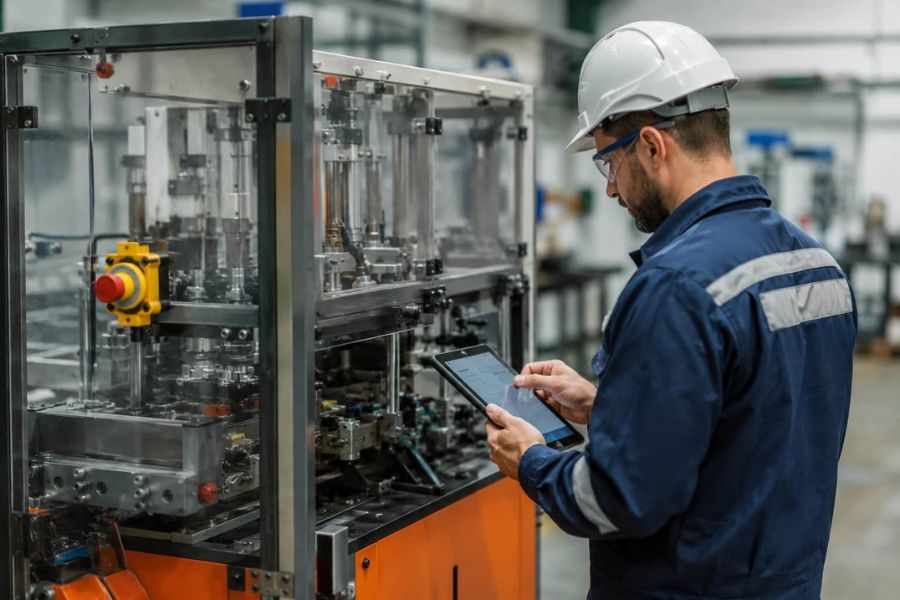

What is CE marking for industrial machinery?
The CE acronym is placed on products, machines, and equipment that, in general terms, fulfil two functions: on the one hand, they allow that product to access the European Market without limitations, and on the other, they inform users and authorities that the equipment or machinery complies with a set of technical requirements and criteria set out by specific directives.
The CE marking translates to safety and reliability, as it is the way the manufacturer or importer makes known that these pieces of equipment are safe. And although on paper it seems a simple operation: my machine is safe and complies with the marked requirements, therefore, I obtain the CE marking; the regulations to apply and the process to follow are not without a certain complexity.
It is for this reason that today we will answer some aspects of this ‘stamp’.
The manufacturer is responsible for the CE marking of equipment.
The manufacturer, or their legal representative if applicable, is responsible for ensuring compliance with the health and safety requirements set out in the relevant regulations.
In the event that several companies, institutions, or individuals have participated in the design or manufacture of a machine or piece of equipment, one of them must be designated as responsible for this purpose.
What happens if my machine does not have the CE marking?
The use of equipment without CE marking carries numerous risks, as such machinery has not undergone the relevant safety checks and could lead to a workplace accident that endangers workers' lives or damages facilities.
Furthermore, commissioning machinery without the CE machinery certificate constitutes a breach of Spanish and European legislation. The manufacturer could face substantial fines and even imprisonment. Likewise, such equipment cannot be sold within the European Union and, if imported, would be held at customs.
How do I get CE marking?
It is the manufacturer who, before commissioning or marketing the equipment, must ensure that the machine complies with legislation. They will also prepare a technical report, provide the equipment instructions, and develop the machine assessment, which must be validated by an accredited body. Finally, the EC declaration of conformity will be drawn up and the CE marking will be affixed to the equipment.
Is individual CE marking of machines or equipment that interact sufficient?
No. Clearly, those pieces of equipment must comply with the appropriate standards for their individual commissioning, but the moment they interact or collaborate, a new assessment must be carried out that takes into account the risks of the whole.
And, what happens when different machines that have CE marking collaborate in a common environment?
Do I have to do all of this myself?
As we've discussed, it is the manufacturer's responsibility to ensure their equipment or machinery bears the CE marking, but they do not have to undertake this process alone. A company specialising in industrial safety can become a great ally in guaranteeing the safety of the company and its workers, generating the necessary documentation, assessing risks, implementing appropriate corrective measures, and declaring the CE marking certificate, which verifies that the equipment complies with European harmonised legislation.