A non-conformity in a machine is not just a technical observation: it may be the sign of a real risk for both the operator and the company.
Many organisations detect these situations after an industrial machinery inspection, a health and safety audit, an internal review or a technical visit. At that point, common questions arise: what does this deficiency mean? Is it mandatory to correct it? Does it affect Royal Decree 1215/1997? Is a risk assessment required? Could it affect CE marking?
The answer depends on each item of equipment, its actual use, its condition, the available documentation and the associated risks. For this reason, non-conformities in industrial machinery have been detected. deben abordarse con criterio técnico, no solo como una lista de puntos pendientes.
What are non-conformities in industrial machinery?
Non-conformities are non-compliances, deficiencies or deviations from safety requirements, applicable regulations, technical documentation, guards, safe operating conditions or necessary preventive measures.
They can affect old machines, modified equipment, automated lines, manual workstations, imported machines or equipment which, despite having CE marking, has undergone changes in its conditions of use.
In practice, a non-conformity may indicate that the machine oes not provide an adequate level of safety against certain industrial machinery risks: entrapment, cuts, crushing, dangerous access points, electrical faults, improper use, lack of instructions or deficiencies during maintenance tasks.
Most Common Non-conformities in Industrial Machinery
Although each piece of equipment must be analysed individually, these are some of the most common deficiencies in industrial machinery más habituales:
- Lack of guards or physical protection in moving areas, transmissions, cutting elements or entrapment points.
- Guards overridden, bypassed or removed, leaving the operator exposed during operation.
- Emergency stops missing, incorrectly positioned or not verified, especially on machines with several workstations.
- Entrapment, cutting, crushing or shearing risks not controlled through suitable technical measures.
- Dangerous access to moving areas, without barriers, interlocks or sufficient separation.
- Lack of safety interlocks or systems that do not guarantee a safe stop when a guard is opened.
- Deficiencies in electrical systems or control panels, such as unsuitable wiring, lack of identification or damaged components.
- Absence of risk signage and visible instructions for safe use.
- Lack of manuals, instructions or technical documentation explaining limits of use, maintenance and safety.
- Old machines not adapted to Royal Decree 1215/1997, especially equipment manufactured before current requirements were applied.
- Modifications carried out without reassessing risks, such as process changes, automation, new tooling or extensions.
- Lack of ISO 12100 risk assessment, which is essential to identify hazards and define risk reduction measures.
- Incomplete or incorrect CE marking, or CE marking without a technical file, especially in new, imported, modified or self-built machinery.
- Risks during maintenance, cleaning, unblocking or format changeover, tasks in which hazards not considered during normal use often appear.
These situations do not always involve the same level of severity. Therefore, detecting the deficiency is not enough: the actual risk must be assessed.
Why is detecting the deficiency not enough?
An inspection can identify the problem, but the company needs to know what to do next.
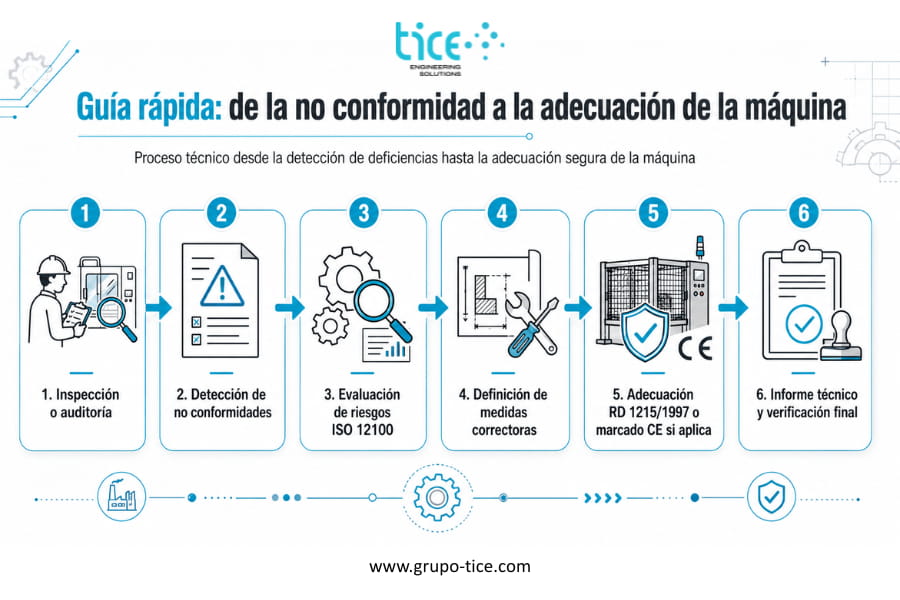
To correct a non-conformity properly, it is necessary to:
- Analyse the actual risk of the machine.
- Assess the severity of the potential harm and the probability of it occurring.
- Define corrective measures for machinery that are both feasible and effective.
- Implement technical solutions adapted to the equipment.
- Document the action carried out.
- Verify that the machine is left in safe operating condition.
In many cases, the solution is not simply to install a guard. It may require redesigning an access point, incorporating interlocks, modifying an electrical manoeuvre, reviewing maintenance procedures or updating technical documentation.
Relationship between non-conformities, Royal Decree 1215/1997, ISO 12100 and CE Marking
Non-conformities may be related to different technical and regulatory frameworks.
The Royal Decree 1215/1997 applies to work equipment in use and establishes the minimum health and safety requirements for its use by workers. Therefore, when a machine is in service within a company, it may be necessary to review whether it complies with the applicable requirements. At Grupo TICE, we provide machinery adaptation to Royal Decree 1215/1997 services to help companies correct deficiencies and improve the safety of their equipment.
The ISO 12100 is a key reference for analysing hazards, estimating risks and defining risk reduction measures. A proper risk assessment according to ISO 12100 makes it possible to technically justify which risks exist and which measures should be applied.
The CE marking for industrial machinery applies especially to new, modified, imported or market-placed machines. It may also be relevant when significant changes are made to an existing machine. In these cases, it is essential to review the documentation, technical file, declaration of conformity and applicable requirements. You can find out more about our CE marking service for industrial machinery.
In addition, a machine with CE marking may still present non-conformities if it has been modified, maintained incorrectly or used under conditions not originally foreseen.
What should a company do after detecting non-conformities?
- Gather the available documentation: manuals, drawings, certificates, electrical diagrams and previous reports.
- Identify the affected machines and their actual use within the production process.
- Carry out a technical risk assessment according to the current condition of the equipment.
- Prioritise critical deficiencies according to severity and personnel exposure.
- Design corrective measures adapted to each machine.
- Carry out the technical adaptation of guards, access points, manoeuvres or safety systems.
- Issue a machinery technical report with the actions carried out and the final documentation.
- Establish periodic reviews para mantener el nivel de seguridad en el tiempo.
Quick Guide: From Non-conformity to Machine Adaptation
How can Grupo TICE Ingenieros help you?
At Grupo TICE , we help industrial companies resolve non-conformities detected in machinery after inspections, health and safety audits, internal reviews or technical assessments.
As a multidisciplinary B2B engineering company with over 20 years of experience, we provide support in:
- Machinery risk assessment according to ISO 12100.
- Industrial machinery adaptation to Royal Decree 1215/1997.
- CE marking for industrial machinery.
- Design and implementation of corrective measures for machinery.
- Preparation of technical reports and final documentation.
- Technical support for health and safety, maintenance, production and engineering managers.
FAQs About Non-conformities in Industrial Machinery
A non-conformity in industrial machinery is a deficiency, non-compliance or deviation related to the safety, documentation, guards, controls, maintenance or conditions of use of a machine.
It may be detected during an inspection, health and safety audit, internal review or technical assessment. In many cases, these non-conformities indicate that the machine requires a risk assessment, corrective measures or technical adaptation to improve its safety.The most common non-conformities are usually related to lack of guards, overridden protections, poorly positioned emergency stops, dangerous access to moving areas, absence of interlocks, electrical deficiencies or lack of technical documentation.
It is also common to detect old machines not adapted to Royal Decree 1215/1997, modifications carried out without reassessing risks, or equipment with incomplete CE marking or insufficient documentation.The recommended approach is not to correct the deficiency in isolation. First, a technical risk assessmentshould be carried out, the actual use of the machine should be analysed, the available documentation should be reviewed and actions should be prioritised according to the severity of the risk.
Afterwards, corrective measures for machinerymust be defined and implemented, the action must be documented and it must be verified that the equipment is left in safe operating condition.Not necessarily. It depends on the type of deficiency, the level of risk, the worker’s exposure and the actual conditions of use.
Some non-conformities may require immediate action if there is a serious risk, while others can be planned as part of an adaptation plan. The important point is to assess each case with technical judgement and document the decision taken.
The Royal Decree 1215/1997 establishes the minimum health and safety provisions for the use of work equipment by workers.
When a machine in use presents safety deficiencies, it may be necessary to carry out an industrial machinery adaptation to Royal Decree 1215/1997, especially in the case of old equipment, modified machines or equipment without sufficient guards.The ISO 12100 is a reference standard for machinery risk assessment and risk reduction. It helps identify hazards, assess risks and define measures to reduce them.
When non-conformities are detected, an ISO 12100 risk assessment makes it possible to technically justify which risks exist, which measures must be applied and how the adopted solution should be documented. Find out more about our ISO 12100 Risk Assessment service here.
Yes. A machine with CE marking may still present non-conformities if it has been modified, if it is used under conditions different from those originally intended, if guards have been removed, if maintenance has not been carried out properly or if there are uncontrolled risks during cleaning, unblocking or format changeover tasks.
The CE marking for industrial machinery is important, but it does not replace a technical review of the equipment in its current condition and actual working environment.A machinery technical report should include the identification of the equipment, the scope of the review, the non-conformities detected, the risk assessment, the corrective measures proposed or implemented and the final verification.
It may also include photographs, drawings, diagrams, applicable regulatory references and complementary documentation that technically justifies the action carried out.The review should be carried out by personnel with technical knowledge of industrial machinery safety, applicable regulations, risk assessment and adaptation solutions.
At Grupo TICE, we act as a specialised engineering company, helping businesses assess risks, define corrective measures, technically document actions and support the adaptation process. Get in touch with us!
Yes. At Grupo TICE , we help industrial companies after inspections, health and safety audits or internal reviews in which non-conformities in industrial machinery have been detected..
Our team can carry out the risk assessment, define corrective measures, execute or coordinate the technical adaptation, prepare the final report and support the company throughout the entire process. Get in touch with us!