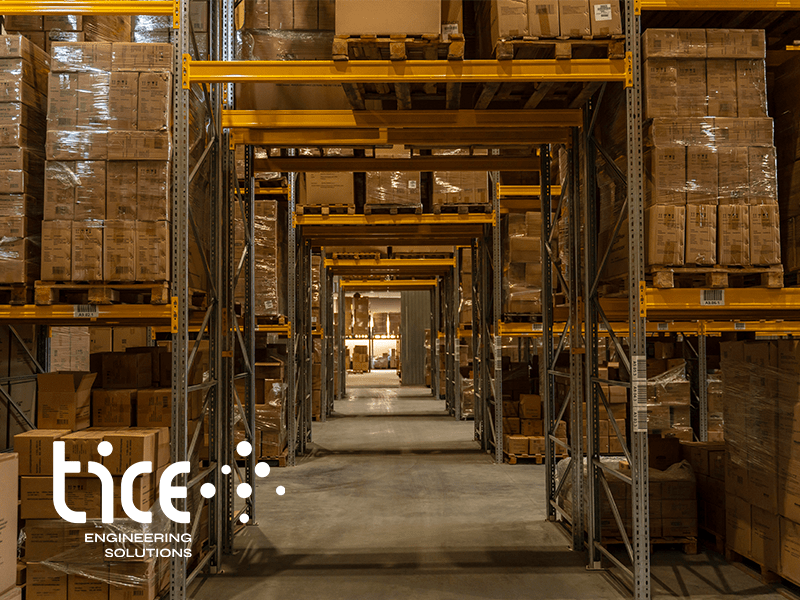
With technical racking inspections, we prevent accidents.
Interview with Miguel Ángel Colorado, COO of Grupo TICE Ingenieros
- What do they consist of? What values are evaluated?
Inspections assess several parameters. On the one hand, the documentation is reviewed, which includes load plates. It would be surprising how many times a business owner loads a shelving unit without knowing its limit. On the other hand, the suitability of the installation is evaluated, checking if its tolerances are within the standard and ensuring its correct arrangement. Lastly, any impacts and accidents encountered are assessed, categorising them according to their severity.
- Why is there so much controversy surrounding racking inspections?
The controversy regarding inspections arises in relation to the regulatory framework in which they are situated. These reviews respond to the needs set out in a UNE-EN standard, which are standards recognised at European level but are not mandatory.
However, Royal Decrees do exist, such as RD 1215 and RD 486, which support the need to carry out these reviews. The standard, of course, should be considered more of a method than a law.
- So, are they mandatory? Why?
We enter the world of occupational risks and, as I said before, work environments and work tools or equipment must be safe, and this is mandated by these Royal Decrees. Therefore, in one way or another, their safe use must be guaranteed. What better way to guarantee this than by using a recognised and prestigious standard that looks after this, such as UNE-EN 15635.
- Regardless of what the standard says, what is recommended regarding these elements?
We don't tend to think that a boiler inspection could be detrimental to us, and yet, the common thought is that a racking inspection penalises the user or is seen as a mere formality.
The spirit of these inspections is not to harm the client's economic health, but quite the opposite. If I didn't truly believe that inspections were of any use, I would dedicate myself to something else.
The safety of people is paramount and the safety of products and goods is second, always important for the proper functioning of businesses.
Furthermore, staff awareness is something to be taken very seriously. From TICE, we offer training courses for staff in which we emphasise the importance of damage reporting and personal awareness as the first element in the fight against accidents.
- How do these inspections benefit the company?
The inspections They are still a form of preventive maintenance, and what is being attempted is to avoid accidents from happening.
Accidents have several economic prejudices for businesses, in addition to social ones. An unsafe working environment tends to create undesirable working conditions.
Regarding the main advantages: avoiding personal injury, as well as losses in stored product or even productive downtime due to supply chain failures.
- What is the procedure if the outcome is unfavourable?
In 95% of cases, the initial report is unfavourable, which does not mean that the issue cannot be easily resolved. Sometimes, with minor adjustments, the warehouse can be made safe again.
Following the inspection, a list of issues to be resolved is issued. The UNE 15635 standard categorises the issues like a traffic light: RED for serious and imminently risky issues, which require immediate action; AMBER for issues that need action, but not necessarily immediately; and GREEN for those that only require monitoring.
Depending on the severity of each of the detected incidents, the actions are defined, moving from AMBER to RED category if they have not been rectified within 4 weeks (as indicated by standard UNE-EN 15635).
Once the incidents are resolved, the warehouse is certified and safe.
- Can a business owner have a warehouse with shelving that has never been inspected? What consequences could this have?
Unfortunately, it's more common than you might think, so I'm grateful for the opportunity I've been given to raise awareness about this issue.
In many cases, the employer is unaware that these regulations or inspections even exist and, in other cases, considers them a cost that contributes nothing (it's not direct production).
In the event of an accident, the competent authority evaluates all possible areas and checks whether effective equipment maintenance has been carried out. If it has not been done, financial penalties, which many fear, may be imposed. However, as I said, the main benefit of these inspections is safety, not avoiding a penalty.
- As a TICE Group technician, what experiences can you share with clients related to these elements?
Over our 10 years of experience as technicians inspecting warehouses, we've encountered absolutely everything: installations with poor initial assembly, very damaged installations where corrective maintenance hadn't been carried out for a long time, and entirely unsafe and unbelievable situations. On many occasions, unbeknownst to the employer themselves.
In any event, I always like to focus on the positives and think that the logistics sector, which traditionally was more concerned with the supply chain than with safety, has made a significant change and is working to ensure its own safety and that of its personnel. Many of our clients, with whom we have been working for years, have undergone a notable evolution in their security, which leaves me with the satisfaction of a job well done.
- What is the value of TICE in this service compared to its competition?
Our service is always customer-focused; we adapt entirely to them and provide a fully personalised service according to their needs. As we don't represent any particular product brand, we enjoy impartiality and brand independence. Furthermore, by having our own R&D department focused on small clients with special needs, we can respond to requirements that standard products do not cover.