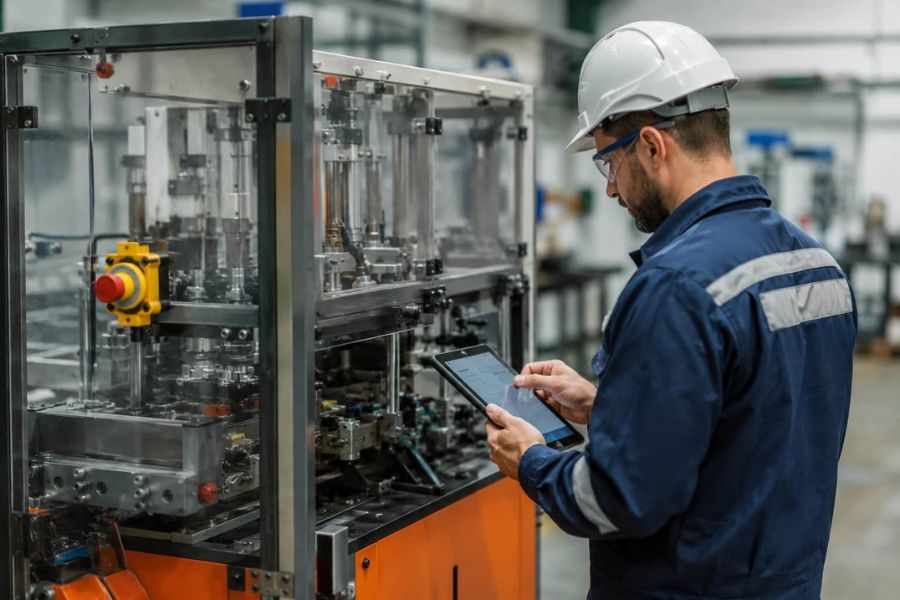
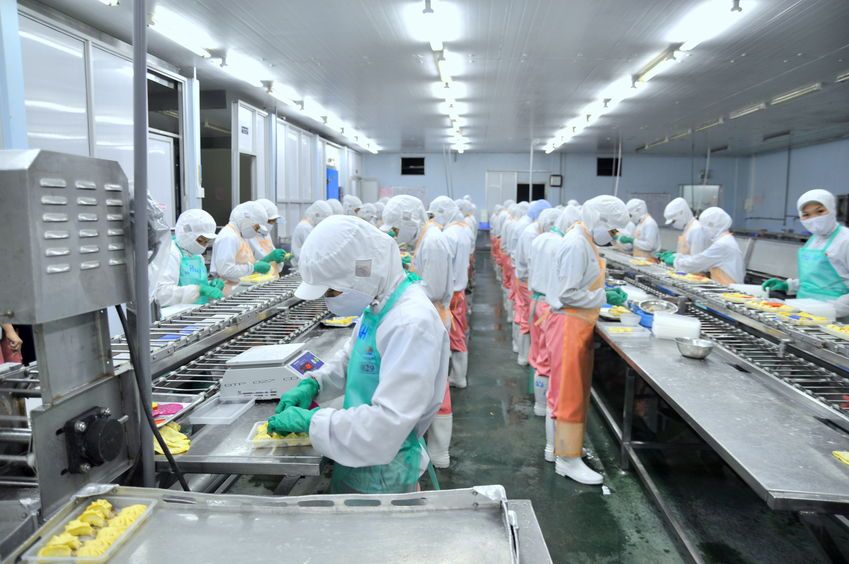
The main occupational risks in food production processes are similar to those recorded in other sectors. The majority of workplace accidents, according to how the injury occurred, are due to musculoskeletal overexertion, collisions with stationary or moving objects, and cuts from objects or manual tools, especially knives. Accidents due to falls on the same level and trapping between objects are also considerable. In this post, we are going to focus on the dangers of Industrial safety associated with machinery in the food sector.
Occupational risks related to machinery in the food industry
Falls Accidents due to falls are usually caused by the state and/or conditions of the floor, uncovered pits, or working at height. For this reason, choosing the right type of approved footwear with anti-slip surfaces, along with a cleaning regime and good maintenance, helps to prevent numerous falls. Also to be used machines with a surrounding flange avoiding water precipitation onto the ground, and optimal drainage must be available to rapidly eliminate liquid accumulation. When working at height, safe means of access to equipment and storage areas must be used; ladders must be sturdy, and fall protection must be in place, including safety harnesses, belts, and lifelines.
Trappedaccidents involving Transmission machinery Throughout the production process, they are relatively infrequent, although when they do occur, they can be serious. The risk of entrapment can occur: due to accessible moving parts of work equipment, such as film-dispensing rollers, shafts, chains that are part of conveyor belts; due to the tipping over of vehicles, mainly forklifts; or due to the collapse of stored products. As preventive measures to be adopted, one must To guard the dangerous part of machines and tools with movable interlocked guards, adjustable or retractable guards, or non-physical barriers such as pressure mats or photoelectric cells. In the mechanical handling equipment, and in particular conveyors, which are widely used in the food industry, must pay special attention to the protrusions that move in their movement. In the Filling and sealing machines must be completely isolated, with the exception of inlet and discharge chutes and belt conveyors, drums, pulleys and gears must be adequately guarded, for instance, to prevent the risk of cuts when canning, effective devices shall be used for the removal of cans with sharp edges or broken glass. Therefore, all machines in operation must be suitable for the Royal Decree 1215/97 and if they are to be marketed in the European Union, they must put the CE Marking.
The unintended startup machinery for transmission during cleaning or maintenance operations must be prevented by strict adherence to Lockout and tagout procedures warning notice. They should be place emergency switches within reach and clearly visible controls that allow the machine to be stopped safely. Work clothing must not be loose to avoid the risk of it getting caught. Likewise, workers must not wear objects that could get snagged, such as rings, bracelets, or other dangling jewellery.
Direct and indirect electrical contacts: Electrical installations require adequate earthing and good maintenance to control the inherent risk of electric shock, especially in damp locations where the presence of water and humidity acts as a conductive medium, thereby exacerbating this risk. In addition to these precautions, socket outlets equipped with residual current devices are effective in protecting against electric shocks. An appropriate electrical classification of hazardous environments is essential. Frequently, seasonings, extracts, and flammable powders, such as those from cereals, corn starch, or sugar (considered as foodstuffs rather than hazardous chemicals), may require the use of rated electrical equipment to eliminate the risk of ignition during process misalignments and deviations. As a general rule, the installation shall be carried out in accordance with current regulations. The electrical installation must comply with the requirements specified in the Royal Decree 842/2002. When using electric forklift batteries, it is recommended to use barriers or enclosures at the terminals and avoid leaving metal objects on top. The electrical panels and cabinets of equipment and machinery shall only be handled by authorised and trained personnel. They shall be fitted with High-sensitivity differential devices that protect the worker from possible deviations and must have a protective cover and electrical risk signage, as well as the corresponding identification of the different circuits that comprise it.
For noise exposureSome mechanical processes in the food industry, particularly canning, generate high noise levels, which constitute a serious health risk. Hearing deterioration occurs as a consequence of continuous and prolonged exposure to noise above recognised threshold levels, and constitutes an incurable illness that causes communication disorders. Workers exposed to this physical risk may suffer a series of negative health effects, including hearing damage such as auditory masking, occupational deafness, and psychologically, stress and anxiety. Provision must be made for a Comprehensive service for the development, manufacture, and assembly of solutions to reduce the transmission of noise and vibrations, generated by machinery in industrial environments.,
In accordance with Royal Decree 286/2006 of 10 March on the protection of the health and safety of workers against risks related to noise exposure, daily exposure levels must be assessed when the risk assessment identifies potential worker exposure to levels exceeding 80 dB. Based on the measured daily exposure levels and peak levels, implement technical and organisational measures to reduce the risk. Ensuring that the degree of noise exposure is not dangerous is the fundamental strategy for noise control, and if collective protection measures are not effective, UNE EN 352-1 helmets or EN 352-2 earplugs must be provided as auditory PPE in those posts where levels exceeding 80 dB are found. In the Royal Decree 286/2006, on the protection of the health and safety of workers against the risks related to noise exposure, laying down minimum provisions for the protection of workers against the risks to their safety and health arising or likely to arise from exposure to noise, in particular the risks to hearing.
Vibrations Vibration-related disorders are associated with an increase in the degree of mechanisation, and food industry machinery, such as band saws, mixers, and knives, generates vibrations. Furthermore, low temperatures increase the likelihood of suffering from these types of disorders in the fingers. Excessive exposure to vibration causes, among other problems, musculoskeletal disorders in the wrists, elbows, and shoulders. The type and degree of ailments depend on the class of machine, how it is used, and the level of oscillation involved. High vibration can lead to the growth of bone protrusions and gradual bone destruction at the joint, resulting in severe pain and/or limited mobility. Therefore, it is necessary to develop insulation systems which reduce the transmission of vibrations by dissipating their energy and preventing transmission by both airborne and structural routes.
In the Royal Decree 1311/2005 provisions are established with the aim of avoiding or reducing worker exposure.