Buying industrial machinery from Chinese manufacturers may seem like a shrewd decision due to price and availability. However, many buyers face legal and technical problems when the machine arrives in Europe: The CE marking it has is not valid.
If you are importing machinery from China, or are considering doing so, This article is for you. We explain the key differences between the genuine European CE Mark and the so-called «China Export», the implications of not complying with European regulations, and How to legalise your machinery before using it in your business.
Why do so many companies import machinery from China?
China is one of the world's largest manufacturers of industrial machinery. Lifting platforms, bending machines, injection moulding machines, robots, shears… many models are offered at unbeatable prices on platforms like Alibaba, Made-in-China or at trade fairs.
But here's the risk: that the machine arrives without valid documentation for the European market, or worse still, that it brings a Falsely CE marked.
CE Marking vs. China Export
the confusion that could cost you dearly
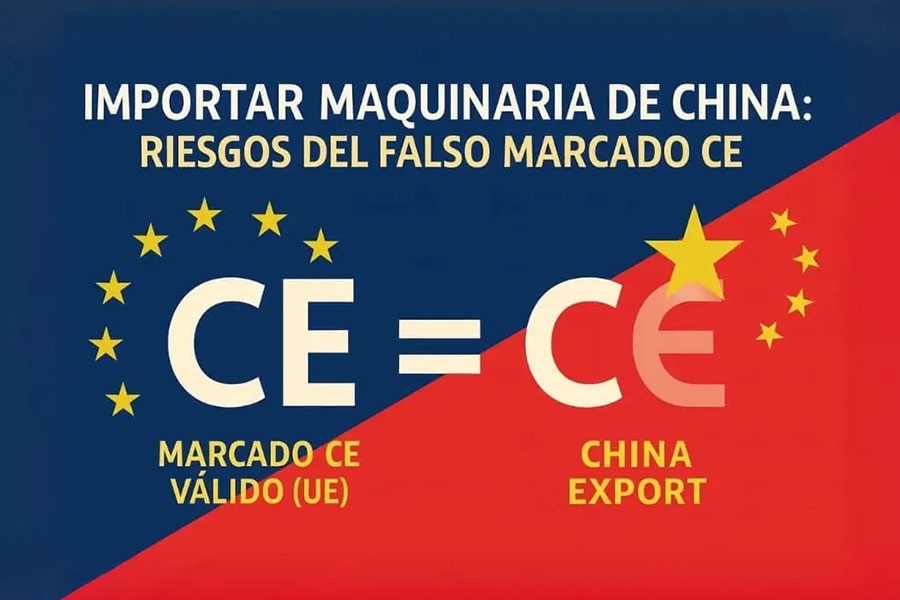
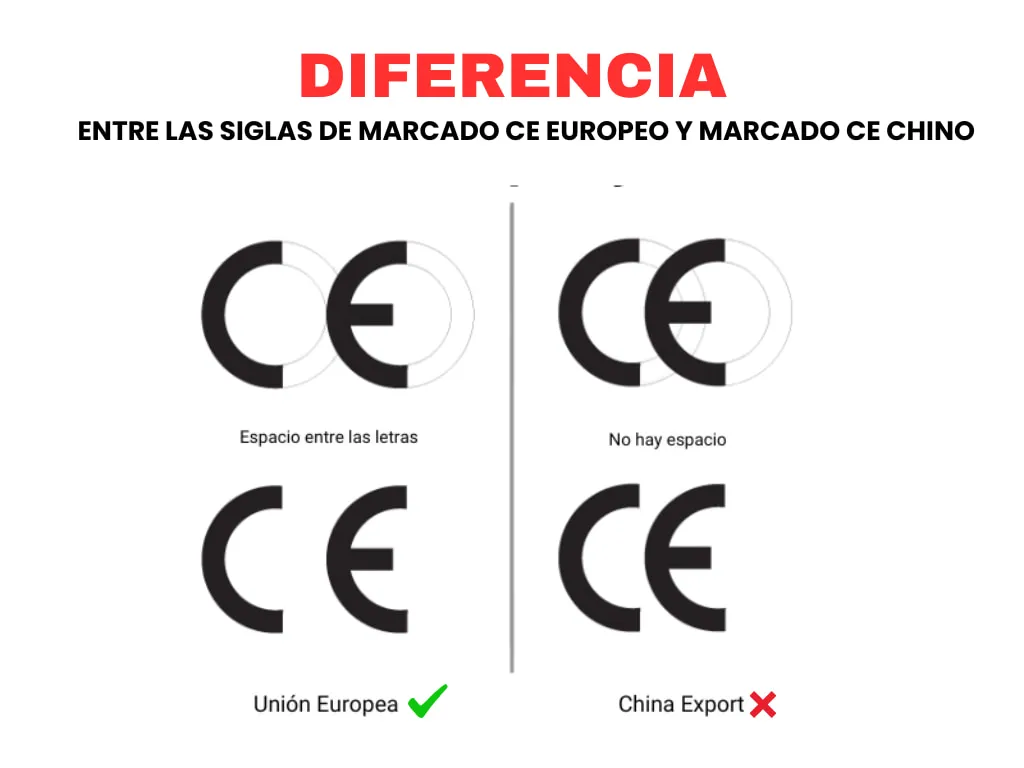
At first glance, the logos are almost identical, but they don't mean the same thing:
 European CE marking: European Conformity. Guarantees that the product complies with the applicable European directives (for machinery, mainly 2006/42/EC).
 China Export: Simple indication that the product has been manufactured in China for export. It does not imply conformity assessment or legality in the EU.
How to tell them apart?
- The Valid CE marking It has more letter spacing.
- The fake “China Export” shows the letters very close together.
- The only reliable way to check it is To check if there is a valid technical file and declaration of conformity.
What are the implications of importing machinery without a valid CE mark?
Importing and putting into service a machine without the correct CE marking could lead to:
Administrative fines and penalties.
Equipment Immobilisation by the Labour Inspectorate or the competent body.
Serious safety risks of your workers.
Inability to pass OHS audits or ISO certifications.
What if you've already bought the machine and it doesn't work?
All is not lost. There are two paths:
- Request full and valid documentation from the manufacturer according to European regulations (rarely achieved).
- Hire an expert to carry out CE marking a posteriori, which implies:
- Risk assessment.
- Suitability of protections.
- Technical file preparation.
- Issuance of the declaration of conformity.
At TICE, we've been helping industrial companies for over 18 years to regularise its imported machinery. Our CE marking service includes the entire analysis and compliance process.
The typical case: machinery that “appears” to comply, but does not
Many clients come to us with machines that bring:
- Incomplete or foreign language manuals.
- CE markings without a notified body number.
- Without a wiring diagram or installation plan.
- No risk analysis or functional testing.
All that It is mandatory. And your absence invalidates the alleged compliance.
Here you can see what it should really include the CE marking technical file, the central point for a machine to be considered compliant.
Which machinery is most affected?
In recent years, we have detected an increase in the import of Chinese machinery in sectors such as:
- Logisticslifting platforms, electric stackers, forklifts.
- Metalworkershears, presses, machining centres.
- AutomotiveCollaborative robots, welding jigs.
- Industry Ceramics or plastics: kilns, extruders, presses.
Almost all of them arrive with Partial or inadequate documentation.
What can you do before buying machinery in China?
Here are a few key recommendations:
- Always request the full technical file before purchasing.
- Ask that you be provided EC declaration in accordance with Directive 2006/42/EC.
- Check the language of the manual (it must be in the language of the country of use).
- Check the physical CE marking (dimensions, spacing, accompanying documentation).
If you have any doubts, consult a specialist. before importing.
Are you interested in this topic?
You can also read here: How do I obtain the CE marking for my machine?