When a company imports industrial machinery, electrical equipment or components from outside the European Union, it is common to find symbols, plates and documents that appear to indicate European compliance. One of the issues that creates the most confusion is the difference between valid CE marking and China Exportespecially when a CE-like symbol appears on imported machinery and it is not clear whether the equipment actually meets the technical requirements applicable in Europe.
This confusion should not be treated as a simple visual detail. In an industrial environment, accepting a machine only because it carries the letters “CE” can create significant risks for the company: worker safety risks, incomplete technical documentation, regulatory non-compliance, inspection issues, internal audit findings or additional costs to adapt the machine after purchas
Before putting imported machinery into service, companies should verify whether the CE marking is supported by valid technical documentation. The key point is not the country of manufacture. A machine manufactured in China, or in any other non-EU country, may be compliant if it has been designed, assessed and documented according to the applicable regulatory framework. The problem arises when a CE-like symbol is used as a commercial claim without a real technical basis to justify the conformity of the equipment.
In this article, we explain what European CE marking means, what is commonly referred to as China Export, how to interpret a China Export CE mark querywhat documentation should be reviewed and which warning signs may indicate that imported machinery needs a technical compliance assessment before use.
Why Is There So Much Confusion Between CE Marking and China Export?
The confusion between CE marking and China Export exists because both concepts are associated with very similar-looking symbols. In commercial photographs, rating plates, technical sheets or instruction manuals, the buyer may see the letters “CE” and assume that the machine complies with European legislation. However, that assumption can be risky if the documentation that accompanies the machine has not been reviewed.
In international industrial purchasing, many decisions are made with incomplete information: a technical datasheet sent by the supplier, a photograph of the machine, a generic certificate or a declaration that does not clearly identify the exact model purchased. This context makes it easier for the buyer to interpret a CE-like symbol as sufficient proof of compliance, when in reality compliance must be supported by coherent documentation and a technical assessment of the equipment.
It is also common for suppliers to use terms such as “CE certified”, “CE approved” or “machine with CE” without providing the documentation required to support those claims. These expressions may sound reassuring, but for industrial machinery, a commercial statement is not enough. The company receiving the equipment should be able to verify that the machine, rating plate, instruction manual, declaration of conformity and technical characteristics all match.
What Does European CE Marking Actually Mean?
European CE marking indicates that the manufacturer declares that the product complies with the applicable requirements within the European Economic Area. It is not a quality mark, it does not mean that the product is better than another product, and it does not always mean that an external body has assessed the equipment.
For many products, the manufacturer may carry out the conformity assessment internally, provided that the correct procedure has been followed. In other cases, depending on the type of product and the applicable legislation, the involvement of a notified body may be required. normativa sobre marcado CE en maquinaria para revisar el marco regulador aplicable a este tipo de equipos.
Therefore, the CE symbol should never be assessed in isolation. A machine may display the CE marking on its rating plate and still present serious deficiencies if it does not have a suitable instruction manual, technical diagrams, correct manufacturer identification or a specific Declaration of Conformity for that machine.CE marking does not replace technical assessment. It is the visible result of a conformity process, provided that the process has been carried out correctly.
What is known as China Export?
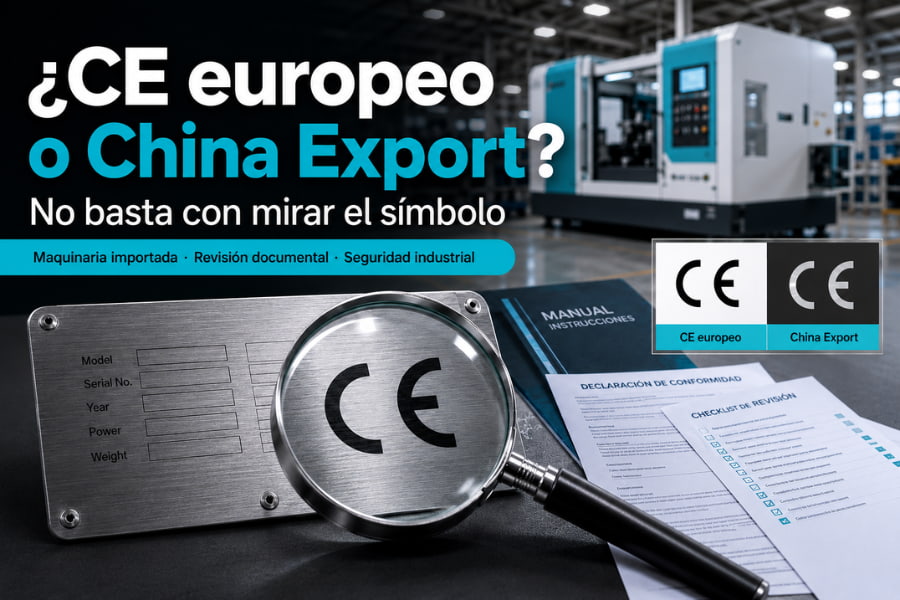
The term China Export CE mark, is commonly used to refer to CE-like symbols that may visually resemble European CE marking and create confusion. Many online searches use expressions such as “China Export CE mark” or China Export CE mark queryto describe a symbol where the letters C and E appear closer together or with proportions that differ from the official European CE marking.
However, from a technical compliance point of view, companies should not rely only on the spacing between the letters. The difference between valid CE marking and China Export The difference between valid CE marking and a doubtful CE-like symbol cannot be solved by looking at the logo alone.
What really matters is whether there is a genuine conformity assessment behind the symbol, a signed Declaration of Conformity, coherent technical documentation and adequate safety measures on the actual machine.In other words, a machine with a visually correct CE marking may still be non-compliant if the documentation is missing, generic or unrelated to the equipment received. Likewise, a machine manufactured in China may be compliant if the manufacturer, importer or party responsible for placing it on the market has fulfilled the applicable technical and documentary obligations.
CE Marking vs China Export: Main Differences
To understand the difference, it is useful to separate two levels: the visual level and the documentary level.The visual level may help detect warning signs, but the documentary and technical level is what allows a company to verify whether there is a real basis for compliance.
| Aspect | European CE Marking | China Export or Questionable CE Marking |
|---|---|---|
| Meaning | Declaration of conformity with the applicable European requirements. | Term used for similar symbols that may cause confusion. |
| Legal value | Allows the product to be placed on the market or put into service if it complies with the applicable regulations. | Does not, by itself, prove that the product complies with European regulations. |
| Documentation | Must be supported by a Declaration of Conformity, user manual and technical file. | Is often accompanied by incomplete, generic or inconsistent documentation. |
| Responsibility | Manufacturer, importer, authorised representative or party responsible for placing the product on the market. | It may not be clear who assumes technical responsibility for the equipment. |
| Application in machinery | Must justify mechanical, electrical, functional and documentary safety. | May hide deficiencies in guards, manuals, diagrams or risk assessment. |
| Technical review | The documentation must match the actual machine. | There may be differences between the commercial datasheet, the nameplate and the equipment received. |
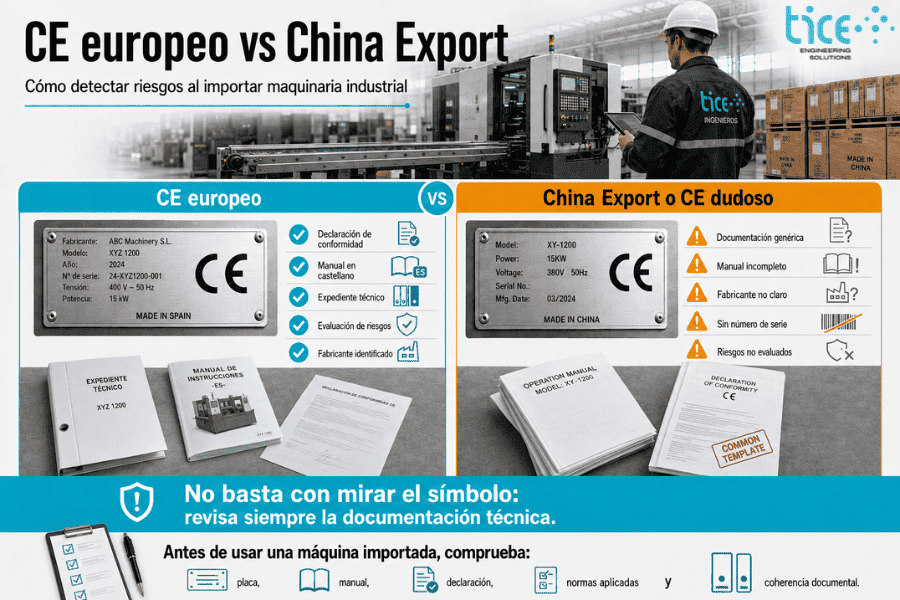
Why Is Looking at the CE Symbol Not Enough?
One of the most common mistakes is assuming that the CE symbol alone proves that a machine is safe. In reality, the symbol is only the visible part of a broader conformity process. If that process has not been performed correctly, the marking loses practical value, even if it is printed on the rating plate.For industrial machinery, conformity must be supported by evidence.
For example, if a machine includes movable guards, there should be an adequate safety logic behind them. If it has trapping, cutting, crushing or projection hazards, those risks should have been assessed. If it includes an electrical control cabinet, suitable electrical diagrams and components should be available. If operators carry out cleaning, adjustment or maintenance tasks, the instruction manual should explain how to perform those operations safely.
That is why, when a company receives imported machinery, it should review both the documentation and the real physical condition of the equipment.The question should not only be: “Does this machine have CE marking?”The real question should be: “Can we demonstrate that this machine meets the applicable requirements and can be used safely?”
Documentation That Should Accompany Imported Industrial Machinery
The required documentation may vary depending on the type of machine, its complexity and the applicable legislation. However, there are basic documents that companies should request whenever they purchase imported industrial machinery.The absence of one of these documents does not automatically mean that the machine is unsafe, but it is a warning sign that the case should be reviewed in more detail.
EU Declaration of Conformity
The Declaration of Conformity should clearly identify the machine, the manufacturer, the model, the serial number where applicable, the legislation applied and the person authorised to sign.A generic declaration, without specific data or referring to a broad product family without identifying the actual machine received, does not provide the same level of documentary confidence.
Instruction Manual
The instruction manual should be available in the language required in the country where the machine is made available to users.It should not be limited to basic start-up and shutdown instructions. It should include information on installation, intended use, prohibited uses, maintenance, adjustment, cleaning, residual risks, safety systems and actions to be taken in the event of faults or incidents.
Rating Plate
The rating plate should allow the machine to be identified. It should be consistent with the Declaration of Conformity and the instruction manual.If the plate does not include the manufacturer, model, serial number, year of manufacture or relevant technical data, the traceability of the equipment is weakened.
Diagrams and Technical Documentation
For many industrial machines, electrical, pneumatic, hydraulic or control diagrams may be necessary.These documents are important for maintenance, fault diagnosis, future modifications and verification of safety-related systems.
Risk Assessment
Risk assessment is an essential part of the CE compliance process for machinery. It makes it possible to identify hazards, estimate risks and define risk reduction measures.If the machine has unprotected hazardous areas, uncontrolled access points, unexpected movements or insufficient emergency stop functions, the documentation should explain how those risks have been assessed and reduced.
How to Check Whether the CE Marking on Imported Machinery Is Valid
To verify whether the CE marking on imported machinery is properly supported, it is not enough to review the rating plate. A documentary and technical check should be carried out.The documentation should match the real machine, its model, serial number, year of manufacture, manufacturer and technical characteristics.Companies should review the following points:
- Check whether there is a signed EC or EU Declaration of Conformity.
- Verify that the instruction manual is available in the required language.
- Confirm that the rating plate is legible and contains sufficient information.
- Check that the model and serial number match across all documents.
- Identify the applicable legislation, directives or regulations.
- Review the harmonised standards used by the manufacturer, where available.
- Request electrical, pneumatic or hydraulic diagrams where relevant.
- Verify whether a risk assessment has been carried out.
- Analyse whether guards, protective devices and stop systems are adequate.
- Confirm that maintenance instructions describe safe operations.
- Check whether residual risks are described in the manual.
- Review whether the machine has been modified from its original design.
If any of these points are unclear, the company should act with caution before putting the machine into service. In industrial machinery, compliance is not demonstrated by a sticker alone, but by a combination of real safety, technical documentation and clearly identified responsibility.
Warning Signs in Machinery With Doubtful CE Marking
Common Mistakes When Importing Industrial Machinery
Many non-conformities do not occur because the company acts in bad faith, but because the purchasing process does not include a prior technical review.Sometimes, the purchasing department requests price, delivery time and production characteristics, but does not verify whether the machine will arrive with the documentation required for safe and compliant use.
Common mistakes include:Buying machinery based only on a commercial datasheet. Accepting generic certificates without checking the exact model. Receiving instruction manuals in the wrong language. Failing to review the rating plate before installation. Not requesting technical diagrams. Installing the machine before assessing its risks. Modifying the machine during integration without checking whether those changes affect safety or original compliance.
Another common mistake is confusing a certificate, a Declaration of Conformity and CE marking.A Declaration of Conformity is not the same as a third-party certificate. CE marking is not equivalent to a full machinery safety audit. Each document has a specific role and should be interpreted as part of the overall technical evidence.
What to Review Before Buying Imported Machinery
The review should begin before the purchase is closed, not once the machine is already installed.If the company requests documentation during the quotation phase, it can detect potential issues earlier and negotiate the necessary clarifications with the supplier.
Before buying the machine, it is advisable to request:A draft or sample Declaration of Conformity. The index of the instruction manual. Photographs of the rating plate. A description of the safety systems. The standards applied by the manufacturer. The exact scope of supply. Electrical, pneumatic or hydraulic documentation where applicable. Information on how the machine will integrate into the existing production line.If the machine is going to be integrated into an existing line, the company should also assess how it will affect access points, movements, emergency stops, safe maintenance and intended use.
If the machine is going to be integrated into an existing line, the company should also assess how it will affect access points, movements, emergency stops, safe maintenance and intended use.This preliminary review can prevent delays during commissioning, unexpected adaptation costs and disputes with the supplier. In industrial projects, detecting a documentary issue before purchase is usually much easier than solving it once the machine is already in the plant.
What to Do If You Already Have Imported Machinery With Incomplete Documentation
If the machine is already in the facility and the documentation is incomplete, the first step is to gather all available information.This may include photographs of the rating plate, instruction manuals, declarations, diagrams, datasheets, quotations, delivery notes, invoices, emails from the supplier and any document that helps identify the origin and characteristics of the equipment.
The next step is to carry out a consistency review. The objective is to verify whether all documents refer to the same machine.If the model in the declaration does not match the rating plate, if the serial number is missing, if the manual corresponds to another version or if the documentation does not mention applicable legislation, the company should request clarification from the supplier.
At the same time, it is advisable to review the actual safety conditions of the machine: access points, guards, controls, emergency stops, protective devices, signage, maintenance risks and possible hazardous energies.
If deficiencies are detected, corrective measures should be assessed before using the equipment or during a controlled commissioning process.What to Do If You Have Doubts About CE Marking and China Export
If a company has doubts about CE marking and China Exportthe recommended approach is to gather all available documentation before using the machine.The company should request the Declaration of Conformity, instruction manual, technical diagrams, photographs of the rating plate, manufacturer identification and any document that supports compliance with the applicable requirements.
After that, the consistency of all documents should be reviewed. The model, serial number, year of manufacture and technical characteristics should match. The declaration should not be generic and should refer to the applicable legislation.If the machine presents visible risks or insufficient documentation, the prudent approach is to carry out a technical review before putting it into service.
At Grupo TICE Ingenieros, we analyse imported machinery, technical documentation and real safety conditions to help industrial companies detect irregularities before using their equipment.If you need to review industrial machinery, verify CE documentation or assess whether a machine complies with the applicable European regulatory framework, our technical team can help. CE marking service for industrial machinery.
FAQs About CE and China Export
Is China Export equivalent to the European CE marking?
No. The term China Export is used to refer to symbols that may look similar to the European CE marking, but it should not be understood as proof of compliance with European regulations. The key point is to verify the technical documentation and the actual conformity of the equipment.
Is it enough for the machine to have a CE symbol?
No. The symbol is only one part of the process. It must be supported by a Declaration of Conformity, an instruction manual and technical documentation that is consistent with the machine.
How can I know whether the CE marking on an imported machine is valid?
You should review the Declaration of Conformity, the instruction manual, the nameplate, the manufacturer, the standards applied and the consistency between the documentation and the actual machine. If there are contradictions, incomplete data or generic documents, a technical review should be carried out.
Is it sufficient for the machine to display the CE symbol?
No. The symbol must be backed by technical documentation, a risk assessment and appropriate safety measures. A nameplate with a CE marking does not replace the technical file or a real technical inspection of the machine.
What should I do if the Declaration of Conformity is generic?
If the declaration does not clearly identify the machine, the manufacturer, the model or the applicable regulations, additional information should be requested and the equipment should be technically reviewed before it is put into service.
What is the China Export logo?
The China Export logo is a common way of referring to symbols that resemble the European CE marking and may cause confusion, especially when there is not enough technical documentation. Although the visual difference may be a warning sign, the documentary review is the most important step.
Can a machine manufactured in China have a valid CE marking?
Yes. The country of manufacture does not determine conformity by itself. A machine manufactured in China can be compliant if it meets the applicable European requirements and has the correct technical documentation.
Who should review an imported machine with a questionable CE marking?
Ideally, it should be reviewed by a technical team with expertise in industrial safety, machinery regulations and CE documentation. This makes it possible to assess whether the equipment is compliant or whether corrective measures are required. At Grupo TICE Ingenieros, we specialise in detecting this type of irregularity. You can also consult our service page on CE marking for industrial machinery. At Grupo TICE Ingenieros, we specialise in detecting this type of irregularity. You can consult our service page on CE marking for industrial machinery.
What are the risks of using imported machinery with incomplete documentation?
It may involve accident risks, inspection issues, liabilities for the user company, shutdowns, internal non-conformities and subsequent adaptation costs.
Who is responsible for issuing the CE certificate for a machine?
The CE certificate is issued by the manufacturer of the machine or, where applicable, their authorised representative within the European Union. They are responsible for ensuring that the equipment complies with applicable regulations and that the technical documentation is correctly prepared.At Grupo TICE, we will assist you throughout this process, preparing the necessary documentation and verifying that your machine meets the required standards for its approval.
How much does it cost to obtain CE marking for an industrial machine?
The cost of obtaining CE marking for an industrial machine can vary significantly depending on the type of equipment, its complexity, the condition of the existing documentation and whether modifications or safety improvements are required to comply with European regulations. Each project involves a different technical scope: assessing a new machine with a good design level is not the same as regularising imported machinery without a technical file or with safety deficiencies.
For this reason, to provide a realistic quotation, it is necessary to analyse the equipment in advance and determine which directives apply, which aspects need to be reviewed and which documentation must be prepared. At Grupo TICE, we carry out this analysis on a personalised basis so that you know the exact scope of the process before starting the certification.
If you need an accurate assessment for your machine, we can help you.
Contact our team and we will advise you with no obligation.
Why is it advisable to rely on experts to certify industrial machinery?
CE certification for industrial machinery requires correct interpretation of Directive 2006/42/EC, the application of harmonised standards and verification that each element complies with the essential health and safety requirements. It is a technical process that goes far beyond reviewing a manual or filling in a form, so working with specialists ensures that the assessment is carried out accurately and without overlooking critical aspects.
At Grupo TICE, we approach this work with a methodical focus aimed at reducing risks. Our team identifies the points that may compromise conformity, proposes feasible solutions and prepares the necessary technical documentation so that the machine can pass audits or commissioning processes without setbacks. This experience allows us to anticipate problems, avoid delays and ensure that each piece of equipment reaches the market with full guarantees of safety and regulatory compliance.